

Table of contents
.png)

TrueFoundry vs OpenRouter: when to choose one over the other



Jon Gitlin
As you scale AI features across LLM providers, you'll need a way to route requests, control costs, and keep production traffic reliable without hand-rolling separate SDKs and billing setups for every model.
If you're evaluating solutions that can help, you might end up deciding between TrueFoundry and OpenRouter.
We'll help you compare the two by breaking down each platform's strengths and weaknesses and how to choose between them.
TrueFoundry overview
TrueFoundry is an enterprise AI gateway and agentic deployment platform built for teams that need production governance, not just model access.
Beyond routing, it covers agent orchestration, prompt management, and model training and fine-tuning under one platform. And it can deploy across your own cloud, on-premises, or air-gapped infrastructure.
Strengths
- Deep infrastructure control: You can self-host TrueFoundry in your own VPC, on-premises, or in an air-gapped environment
- Broad platform beyond the gateway: Agent deployment, training and fine-tuning, and prompt management live alongside routing, so teams building more than a simple gateway don't need a separate stack

- Enterprise-grade governance: Access role-based access control (RBAC), per-user and per-service rate limits, configurable guardrails (PII filtering, toxicity detection), and custom Python rules for policy enforcement to prevent sensitive data from leaking
- Multi-model and self-hosted model support: Routes to major providers (e.g., OpenAI, Anthropic, Google) and self-hosted open-source models (LLaMA, Mistral) through vLLM, SGLang, KServe, and Triton
Weaknesses
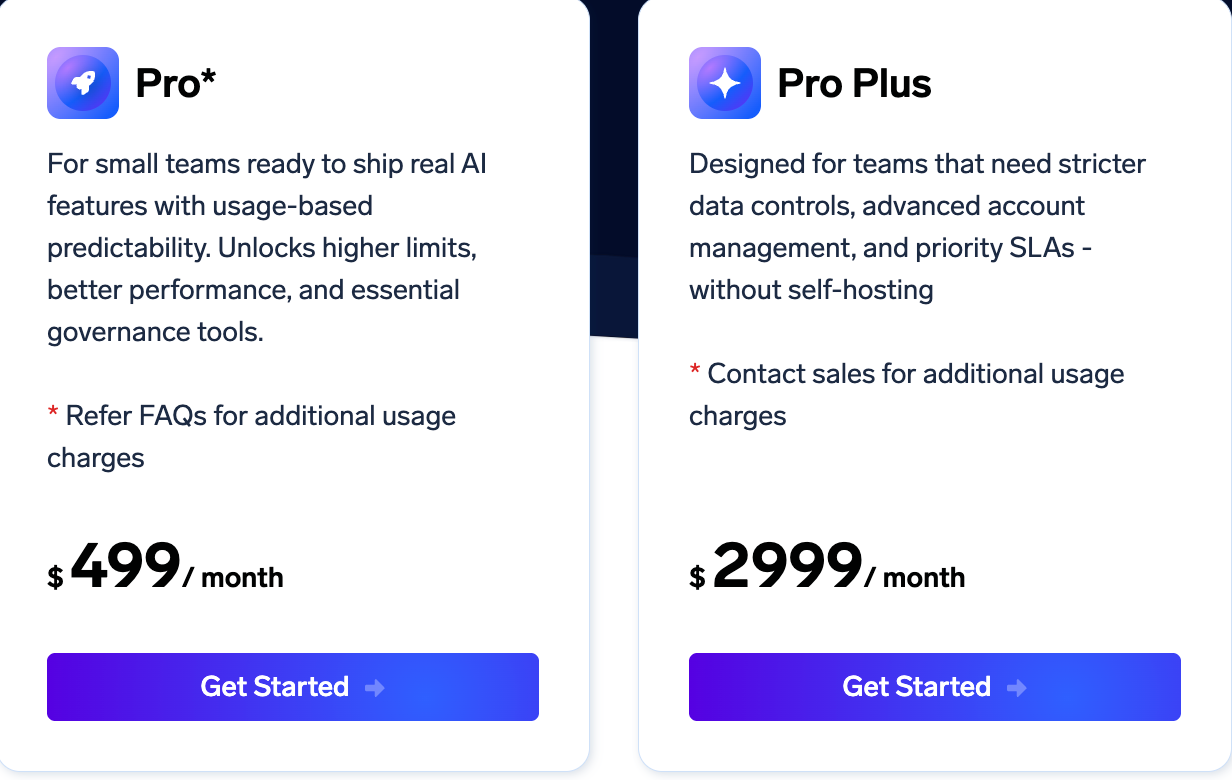
- Steep pricing jump across plans: Production-grade governance, like stricter data controls, sits behind the Pro Plus tier at $2,999/month, a big jump from the $499/month Pro plan
- Routing is rule-based, not benchmark-driven: Routing decisions run on latency, weighted load balancing, and geo rules; there's no built-in way to route based on your own quality or evaluation benchmarks
- No customer-level cost attribution: Dashboards break down spend by model, team, or geography, not by end customer, so teams reselling AI usage to their own customers don't get built-in per-customer billing data
Related: A guide to TrueFoundry alternatives
OpenRouter overview
OpenRouter is a unified API for accessing over 400 models across more than 70 providers. It's also OpenAI SDK-compatible, and doesn’t require a subscription to start.
Strengths
- Broader model catalog: Access over 400 models across 70+ providers through one OpenAI-compatible API. This means switching models doesn't require rewriting your integration

- Generous no-commitment pricing: Sign up with a free tier and spend up to $25,000 on monthly inference at list price before any platform fee applies
- Fast evaluation surfaces: Use their public Chat playground, model Rankings, and Apps directory to see what's performing well and what others are building before you commit
Weaknesses
- No self-hosting option: OpenRouter is cloud-only, so teams that need VPC, on-premises, or air-gapped deployment for compliance reasons can't run it in their own infrastructure
- Key security and governance features aren’t on the free tier: SSO/SAML, contractual SLAs, and managed policy enforcement are Enterprise-only; the self-serve tiers also don't include built-in data loss prevention (DLP) or prompt-injection protection

- Spend visibility stops at org, workspace, or project: There's no granular per-customer or per-feature cost attribution for teams billing AI usage back to their own customers
- Platform fee still applies at scale: A 5% fee on list-price inference kicks in above the $25,000/month allowance, which adds up for high-volume production traffic
Related: A look at OpenRouter’s top competitors
OpenRouter vs TrueFoundry
Weighing TrueFoundry's infrastructure control against OpenRouter's breadth and simplicity can make the choice feel close. Here are a few simple rules of thumb make the decision easier.
- When to use TrueFoundry: You need enterprise governance and the option to self-host
- When to use OpenRouter: You want the broadest model catalog with minimal setup and a large user community
Introducing Merge Gateway: the best alternative to TrueFoundry and OpenRouter
Merge Gateway is a unified API and control plane for routing, governing, and monitoring LLM usage across every major provider from a single endpoint.
It offers:
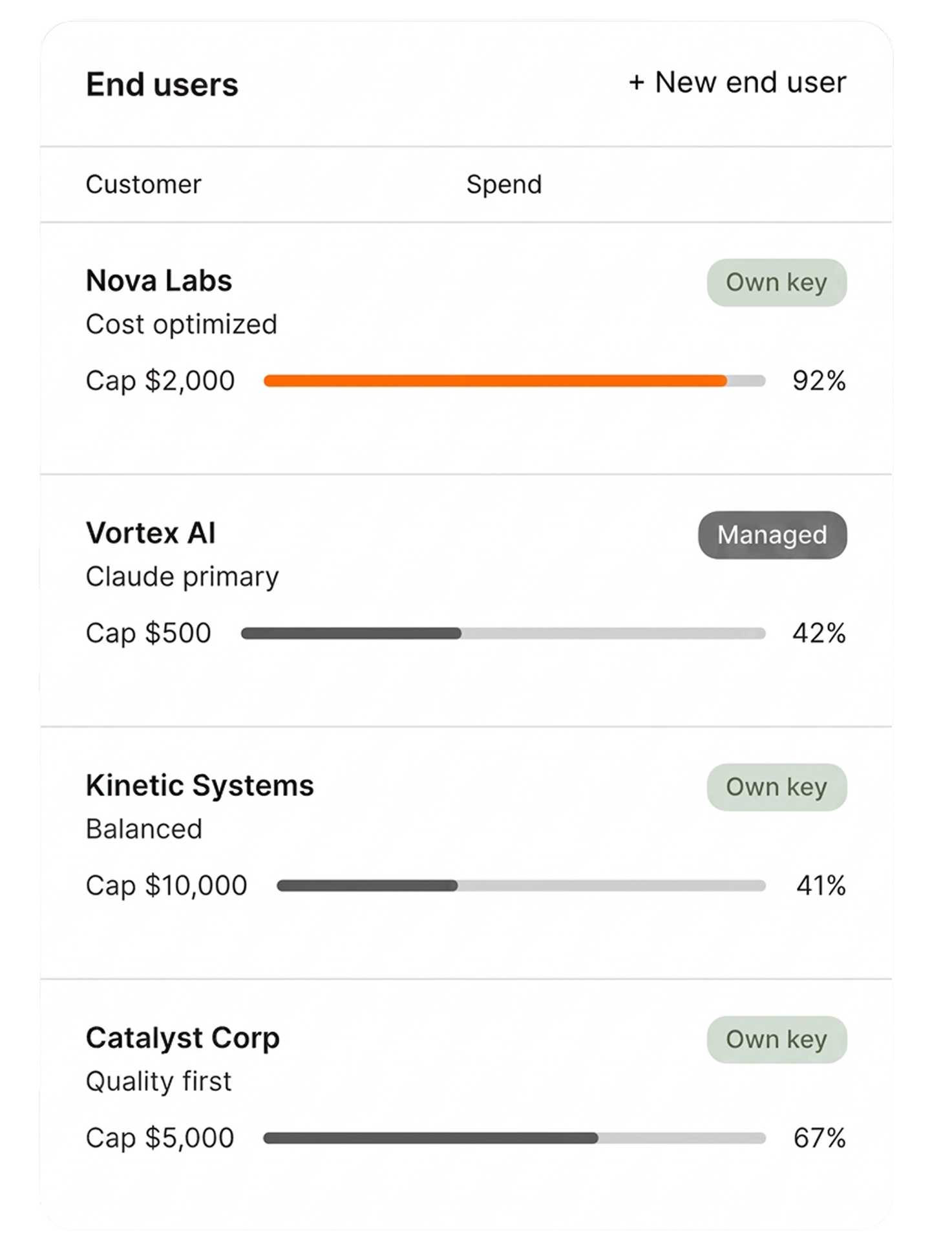
- Per-customer and per-feature cost attribution: Track spend down to the customer, project, team, or feature (OpenRouter's visibility stops at org or workspace and TrueFoundry's dashboards break down by model, team, or geography, not by end customer)
- Built-in DLP and prompt-injection protection: These ship by default with Merge Gateway, instead of sitting behind OpenRouter's Enterprise tier or requiring custom Python rules like TrueFoundry
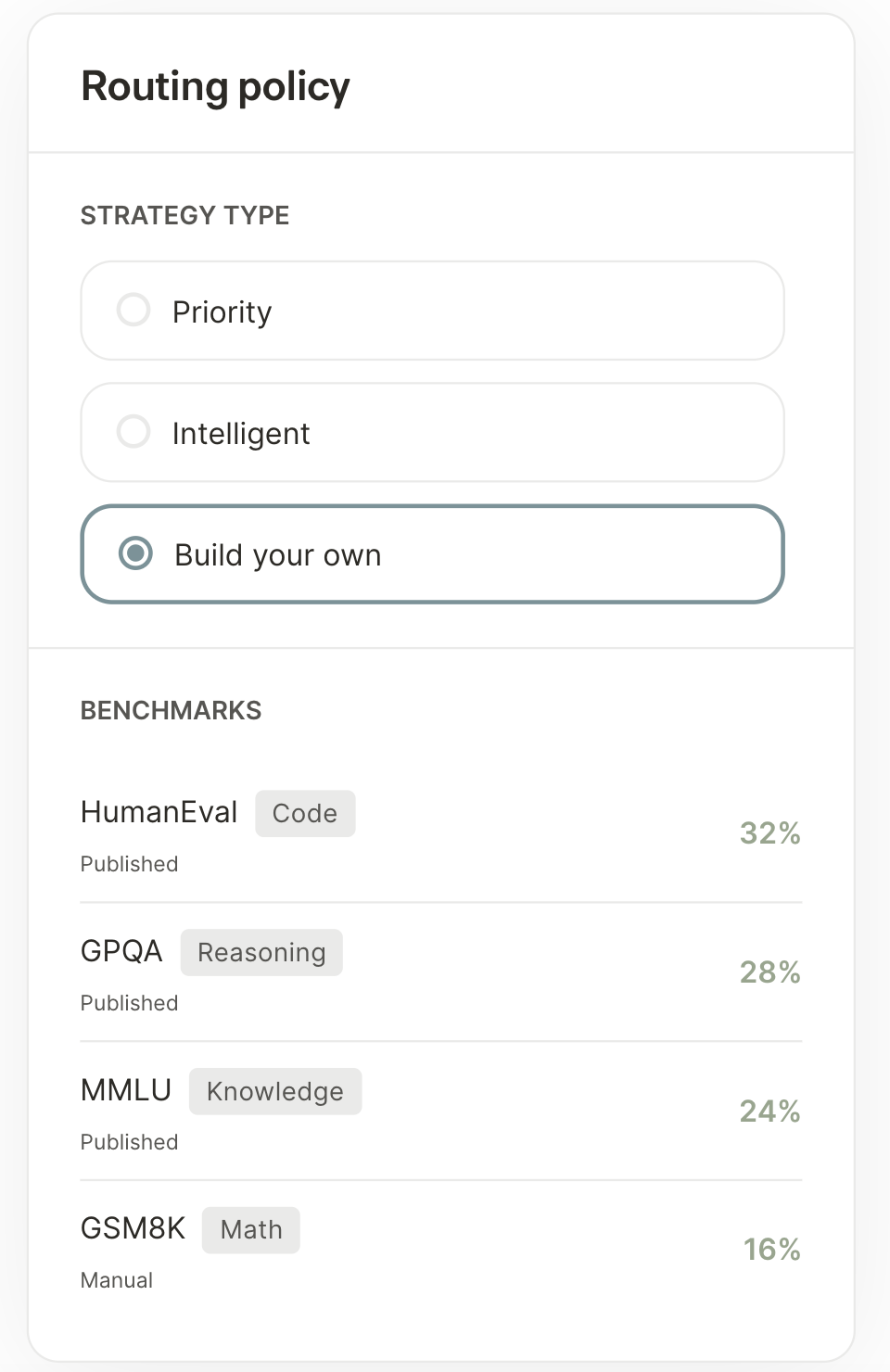
- Route on your own definition of "best": Merge Gateway scores models against your own benchmarks so you control what "best" means, rather than routing on fixed latency and weighted rules like TrueFoundry or reading OpenRouter's public Rankings
- Give your own customers their own controls: The Embedded Routing Stack lets you expose routing policies, credentials, budgets, and usage limits directly to your customers through an API, a layer neither OpenRouter's project-level controls nor TrueFoundry's per-user RBAC extends to
{{this-blog-only-cta}}
Jon Gitlin



Don’t settle for TrueFoundry or OpenRouter
Get started with Merge Gateway for free and put your own routing, spend, and governance rules in place from day one.


But Merge isn’t just a Unified
API product. Merge is an integration platform to also manage customer integrations. gradient text
But Merge isn’t just a Unified
API product. Merge is an integration platform to also manage customer integrations. gradient text
But Merge isn’t just a Unified
API product. Merge is an integration platform to also manage customer integrations. gradient text
But Merge isn’t just a Unified
API product. Merge is an integration platform to also manage customer integrations. gradient text