

Table of contents

.avif)
3 Pipedream alternatives to consider in 2026



Jon Gitlin
Pipedream offers a suite of integration and automation solutions for your internal workflows, products, and agents.
Before using the solution, it’s worth comparing it to similar, competing platforms. We’ll help you do just that by breaking down a short list of the best alternatives.
Merge
Merge offers a unified API that lets you add hundreds of integrations to your product, as well as Merge Agent Handler, which lets you connect your agents to thousands of tools and monitor and manage tool calls.
Top features
- Cross-category integration support: Whether you’re building integrations for your agents or products, Merge lets you connect to a wide range of software, including CRMs, HRISs, file storage platforms, etc.
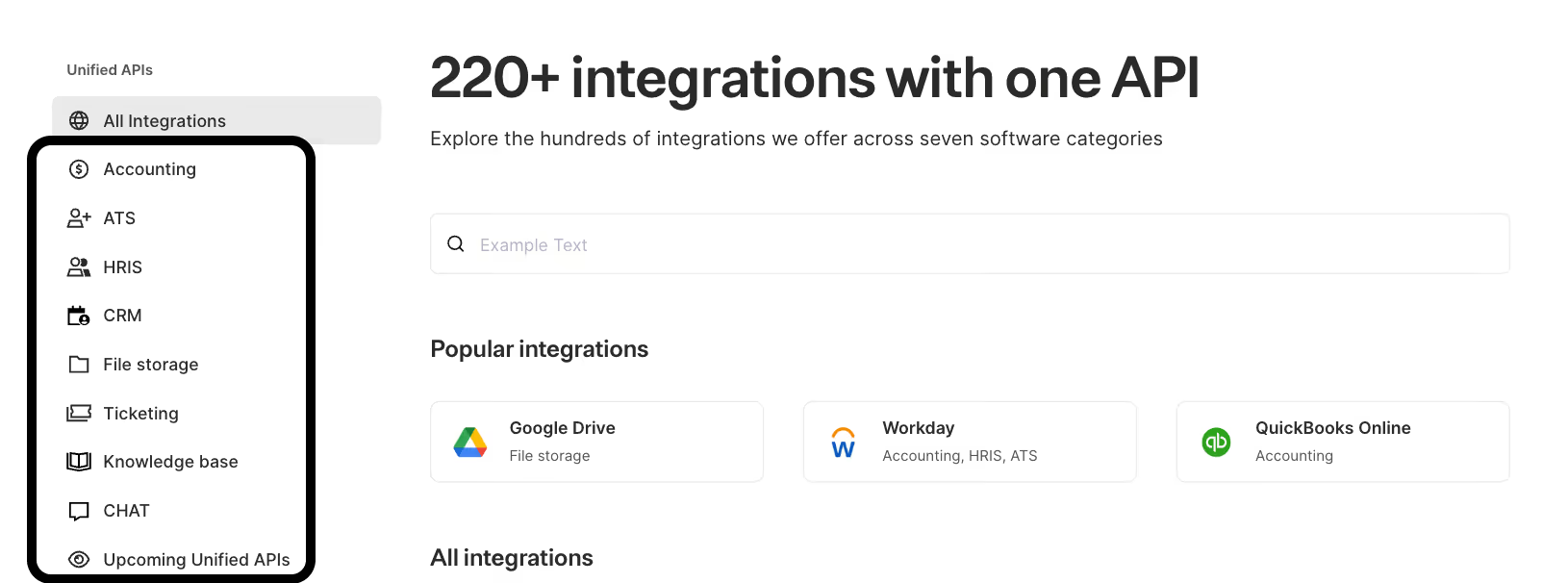
- Integration observability: Merge offers enterprise-grade monitoring features for its products. This includes fully-searchable logs, automated alerts, audit trails, and role-based access controls

- Post-sales support: Merge has a team of solution architects and customer success managers that help customers implement Merge’s integrations and realize increasing value from them
When to choose Merge over Pipedream
- You want to use a more proven integration solution. Merge has hundreds of reviews on sites like G2, while Pipedream only has a handful. In addition, Merge has case studies with enterprise companies across industries, such as Ramp, Mistral AI, and Drata, while Pipedream only has a few (and they’re buried in the company’s blog)
- You need a scalable product integration solution. Merge lets you add hundreds of integrations to your product in weeks via its unified API. Pipedream, on the other hand, forces you to build one integration at a time, which significantly slows your time to market
- You want to partner with a fast-moving company. Merge is launching several integrations every week. And the team is consistently releasing other key product and security features (e.g., a multi-tenant environment in another region). Workday’s recent acquisition of Pipedream makes Pipedream’s future priorities unclear and may compromise their ability to execute quickly
{{this-blog-only-cta}}
Composio
Composio is a developer-first platform for connecting your agents to third-party tools.
It provides a large catalog of pre-built integrations and exposes those integrations as “tools” an agent can call, so teams don’t have to build and maintain every connector from scratch.
Top features
- MCP server marketplace: Composio offers a marketplace of 500+ MCP servers. This includes file storage tools, education and LMS platforms, communications solutions, and more
- SDKs and framework adapters: They offer SDKs (Python and TypeScript) and adapters for popular agent frameworks, so developers can wire tool-calling into existing agent stacks
- Tool-call logs: They provide tool call logs that capture details like timestamps, which tool was invoked, inputs, and whether the call succeeded
When to choose Composio over Pipedream
- You need more customer proof points. Similar to Merge, Composio offers more cross-industry customer case studies on their site. This should help you feel more confident in the solution and enable you to get internal buy-in on using it more easily
- You’re looking for robust logging. Composio offers tool call logs with a variety of details (as mentioned earlier), while Pipedream’s logs don’t come with this level of detail out of the box, forcing you to build out your logging infrastructure or use a separate monitoring solution
- You want fine-grained control over how tools appear to your agents. Unlike Pipedream, Composio supports code-based schema “modifiers.” These let you reshape tool inputs and outputs, such as renaming fields, hiding parameters, or simplifying responses, so the agent calls tools more reliably and with fewer mistakes
Related: A look at Composio’s top alternatives in 2026
Arcade.dev
Arcade.dev, or simply Arcade, is an AI tool-calling platform that helps agents securely take actions across third-party tools.
Top features:
- Broad connector coverage: Supports a wide range of tools (8,000+) and MCP connectors (40+), enabling you to support a wide range of agentic use cases
- Langsmith agent builder: You can describe the tasks you want an AI agent to perform in natural language, and the builder can automatically generate, connect, and configure a production-ready AI agent with the appropriate tools and behaviors. You can also use and build off of their agent templates
- Tool customization: If you need more flexibility than their pre-built connectors provide, you can run your own MCP server, implement custom tools as real code, and expose them to your agents as callable actions
Related: A guide on the top alternatives to Arcade.dev
When to choose Arcade.dev over Pipedream
- You only want an agent integration solution. Arcade.dev specializes in agent connectivity, while Pipedream supports a range of API and MCP-based integration use cases. Since they have a similar employee count (~25), it’s fair to assume that Arcade has more engineering resources allocated to their agent integration platform
- You want more influence on the integration roadmap. Arcade was founded more recently than Pipedream (2024 vs 2019). Because Arcade is an earlier-stage company, they’re likely still shaping their product and ecosystem, which can give you more influence on the connectors they build and prioritize improving
- You’d like to work with more technical founders. Arcade’s founders include a former product leader at Okta, AI engineering leader at Redis, and CTO at a fintech startup. Pipedream’s CEO and founder has a more business-oriented skillset, with a background in investment banking and business development before becoming a CEO
{{this-blog-only-cta}}
Jon Gitlin
.png)
.png)

Don't settle for Pipedream
Learn how Merge can help you build more reliable and secure integrations for your products and agents by scheduling a demo with one of our integration experts.


But Merge isn’t just a Unified
API product. Merge is an integration platform to also manage customer integrations. gradient text
But Merge isn’t just a Unified
API product. Merge is an integration platform to also manage customer integrations. gradient text
But Merge isn’t just a Unified
API product. Merge is an integration platform to also manage customer integrations. gradient text
But Merge isn’t just a Unified
API product. Merge is an integration platform to also manage customer integrations. gradient text