

Table of contents
.avif)
Hosted MCP platforms: overview, benefits, and the top vendors
.avif)


Jon Gitlin
If you’re building AI agents, you’ll inevitably need to connect them to Model Context Protocol (MCP) servers. Only then, your agents can actually execute tasks, whether that’s creating tickets, submitting PTO requests, emailing candidates, and so on.
You have 2 options for connecting your agents to MCP servers:
- Build directly to the software vendors’ MCP servers (i.e., use their official MCP servers)
- Use a 3rd-party solution’s hosted MCP servers
The first approach means you need to run and operate the MCP server yourself (e.g., in your own cloud environment). It also forces you to use MCP servers that may not be well managed and, in many cases, lack the breadth and depth of tools your agents need.
This article covers why you should adopt hosted MCP platforms instead, as well as the top options for you to choose from.
But to start, let’s align on how hosted MCP platforms work.
Note: This article was written on 3/2/2026. Anything outlined below can change.
What are hosted MCP platforms?
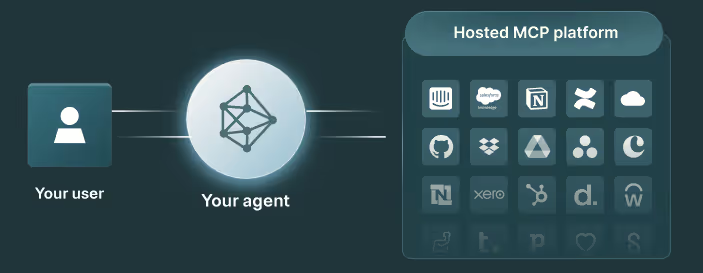
They’re platforms that build, host, and manage MCP servers on your behalf. As part of this, they provide battle-tested tools, authentication support, observability on tool calls, and, in some cases, data loss protection (DLP) functionality.
Related: What's an MCP Gateway?
What are the benefits of using Hosted MCP platforms?
The benefits can vary, depending on the hosted platform you choose and the agentic integrations you build. That said, here are a few benefits that apply to using most hosted MCP platforms:
Time savings for engineering
By enabling your engineers to avoid building MCP connectors, along with agent tool-calling observability, they can save hundreds of hours every year. They can reallocate these time savings towards building the actual agents
This is exactly what we’ve seen from working with Telnyx, which offers low-latency voice AI agents.
According to their COO, Ian Reither:
“Our engineers have been able to save hundreds of hours this year by outsourcing MCP connector development and maintenance to Merge. This has enabled them to fully focus on building the leading full-stack platform for real-time conversational AI.”
More secure and reliable agentic connections
Official MCP servers were largely implemented for marketing.
They often lack built-in authentication, have an incomplete toolset, and use shallow tool descriptions. This can lead your agents to support limited use cases, make the wrong tool calls, share sensitive data to unauthorized users, and more.
We’ve validated this in our own research.
When we asked hundreds of AI leaders with experience in using MCP servers (as part of our 2026 state of agentic integrations), we found that 3 in 4 companies will use a hosted MCP server over the coming year.

Seventy two percent of companies said that this decision comes down to MCP servers’ security risks—like credential leaks, malicious servers, and tool-poisoning—which require specialized expertise to address.
Ability to scale your agentic integrations
Building directly to MCP servers isn’t just resource intensive; it also extends your integrations’ time to market.
Each MCP connection can take weeks to implement, and if your employees or customers need your agents to support a long-tail of connections, this can prevent your agents from getting widely adopted for a significant stretch of time.
Hosted MCP servers help accelerate your time to market by offering hundreds of connectors out of the box across software categories, from CRM to ticketing to chat.
Observability and alerting support
Once you connect your agents to MCP servers, you’ll need to verify that the tool calls meet your performance and compliance requirements. And when they don’t, your team needs to find out as soon as possible so they can react swiftly.
Official MCP servers typically don’t provide this level of support out-of-the-box, while 3rd-party hosted MCP platforms do (although, as we'll cover in the following section, this’ll vary by provider).
The best hosted MCP platforms in 2026
Here’s a shortlist of the best MCP platforms currently on the market.
Merge Agent Handler
Merge Agent Handler offers thousands of tools across dozens of MCP connectors to power a wide range of internal and customer-facing agentic use cases.
Pros
- Enterprise-grade observability features: You can access fully-searchable logs, alerts based on rule violations, audit trails, and more to observe and troubleshoot any potential security incidents
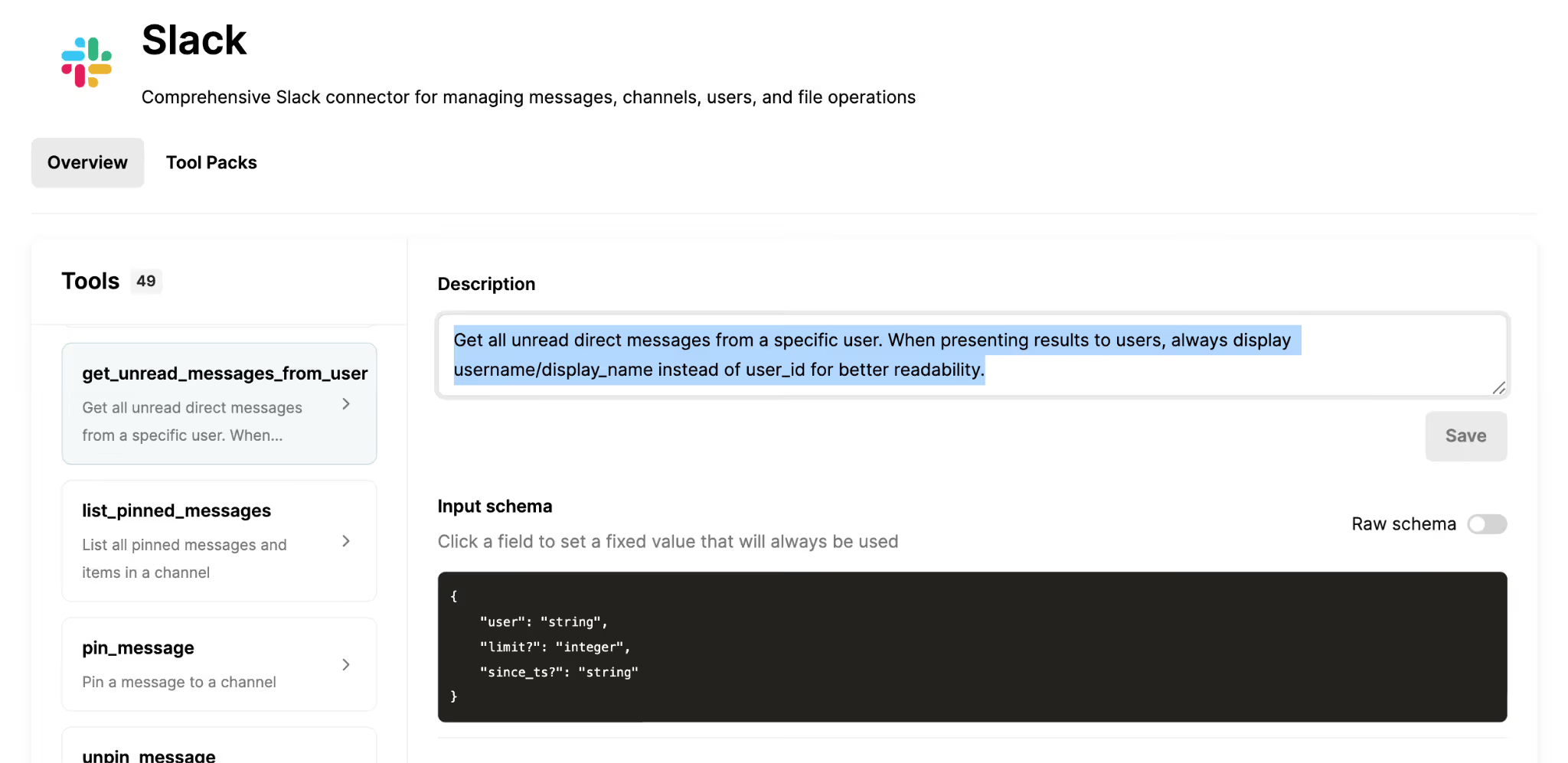
- Best-in-class MCP connectors: Each connector provides a broad tool surface area, clear and reliable tool definitions (descriptions and input schemas), and configurable customization so teams can adapt tools to their workflows
- Shipping velocity: Every week, Merge Agent Handler is releasing several connectors alongside other meaningful platform enhancements, whether it’s related to the UX, the Evaluation Suite, backend improvements, etc.
- Customer proof points: Many cutting-edge AI companies have already seen success from using Merge Agent Handler, such as Perplexity and Telnyx
{{this-blog-only-cta}}
Composio
Composio is a developer-first platform that provides pre-built connectors/tools plus SDK-based integration, where you authenticate users and then invoke tools using identifiers tied to those credentials (e.g., auth config IDs).
Pros
- Developer-first SDK approach: SDKs and adapters can make it easier to wire tool calling into codebases and agent frameworks
- Broad pre-built tool catalog: Offers hundreds of pre-built connectors and tools to speed up experimentation and prototyping
- Configurable schemas/modifiers: Supports customizing how tools are presented/behave via code-based schema modifiers
Cons
- Paywalled security and governance: Audit logs and RBAC are only on higher tiers, and they provide minimal insight on their rule-based alerts, logging, and audit trail coverage
- Complex pricing plans: Composio’s pricing uses multiple meters (tool calls, premium tool calls, and connected accounts), which can make it difficult to forecast spending
- Manually-intensive to set up and maintain: Composio forces you to manually curate the exact set of connectors/tools per use case and maintain that list over time
Related: A guide to Composio’s top alternatives
Arcade.dev
Arcade.dev (or simply Arcade) is an AI tool-calling platform that helps developers give LLMs or agents a catalog of third-party “tools” to take actions in other apps, with authentication and permissions handled in their platform.
Pros
- Pricing is in familiar units: Arcade uses a mix of monthly active users (MAU) and tool calls, making it relatively easy to guess your level of spend
- Large connector catalog: Arcade offers more than 100 connectors, which can help you integrate your agents with the long-tail of software
- Special pricing for certain organizations: Arcade offers more accessible pricing for certain types of organizations (educational institutions, startups, and nonprofits). If your business falls into one of these categories, you may be able to access more cost-effective pricing
Cons
- Connector quality: Their connector ecosystem includes community-managed/open-source connectors, which may be less verified or performance-tested than fully-managed connectors
- Unproven impact: Arcade doesn’t list customers publicly (only potential partners), which makes it harder to fully trust and make the case for the platform
- Potential auth-model friction: Tool calls appear to be user-session–scoped (USER_ID + ephemeral session auth), which doesn’t naturally support multi-user/shared-agent (“crew”) workflows where you need workspace principals, delegation, durable credentials, and clean attribution
Jon Gitlin
.png)



Ready to implement agentic integrations at scale?
Learn how Merge Agent Handler's enterprise-grade MCP servers enable you to support secure and reliable agentic integrations.


But Merge isn’t just a Unified
API product. Merge is an integration platform to also manage customer integrations. gradient text
But Merge isn’t just a Unified
API product. Merge is an integration platform to also manage customer integrations. gradient text
But Merge isn’t just a Unified
API product. Merge is an integration platform to also manage customer integrations. gradient text
But Merge isn’t just a Unified
API product. Merge is an integration platform to also manage customer integrations. gradient text