

Table of contents
.jpg)
.png)
Arcade vs Composio: when to choose one over the other


Jon Gitlin
As you look to connect your AI agents with 3rd-party software, you’ll need to evaluate a wide range of agent integration solutions.
Regardless of your criteria and use cases, Composio and Arcade will likely make it on your short list.
We’ll compare the two to help you decide which, if either, is the better fit for your agents.
Composio overview
Composio is a developer-first, framework-agnostic platform for tool-calling and managed auth. It gives AI agents a catalog of 1,000+ toolkits plus execution primitives like sessions, connected accounts, and triggers.
Pros
- Large integration/tool catalog: Composio supports 1,000+ apps via toolkits, giving teams fast coverage across many SaaS categories
- Agent-native execution primitives: Beyond “tool calling,” Composio emphasizes agent runtime patterns like context-aware sessions, and related higher-level constructs that can speed up multi-step workflows
- Breadth of dev integration options: Their SDKs (including Python and TypeScript) and an ecosystem integrations make it straightforward to embed into code-centric agent stacks
Related: The top alternatives to Composio
Cons
- Governance depth: Composio markets scoped/logged calls and compliance, but what’s less clear is how deep enforcement controls go. For example, it’s unclear if they let you set policies that determine what data types agents can access and share
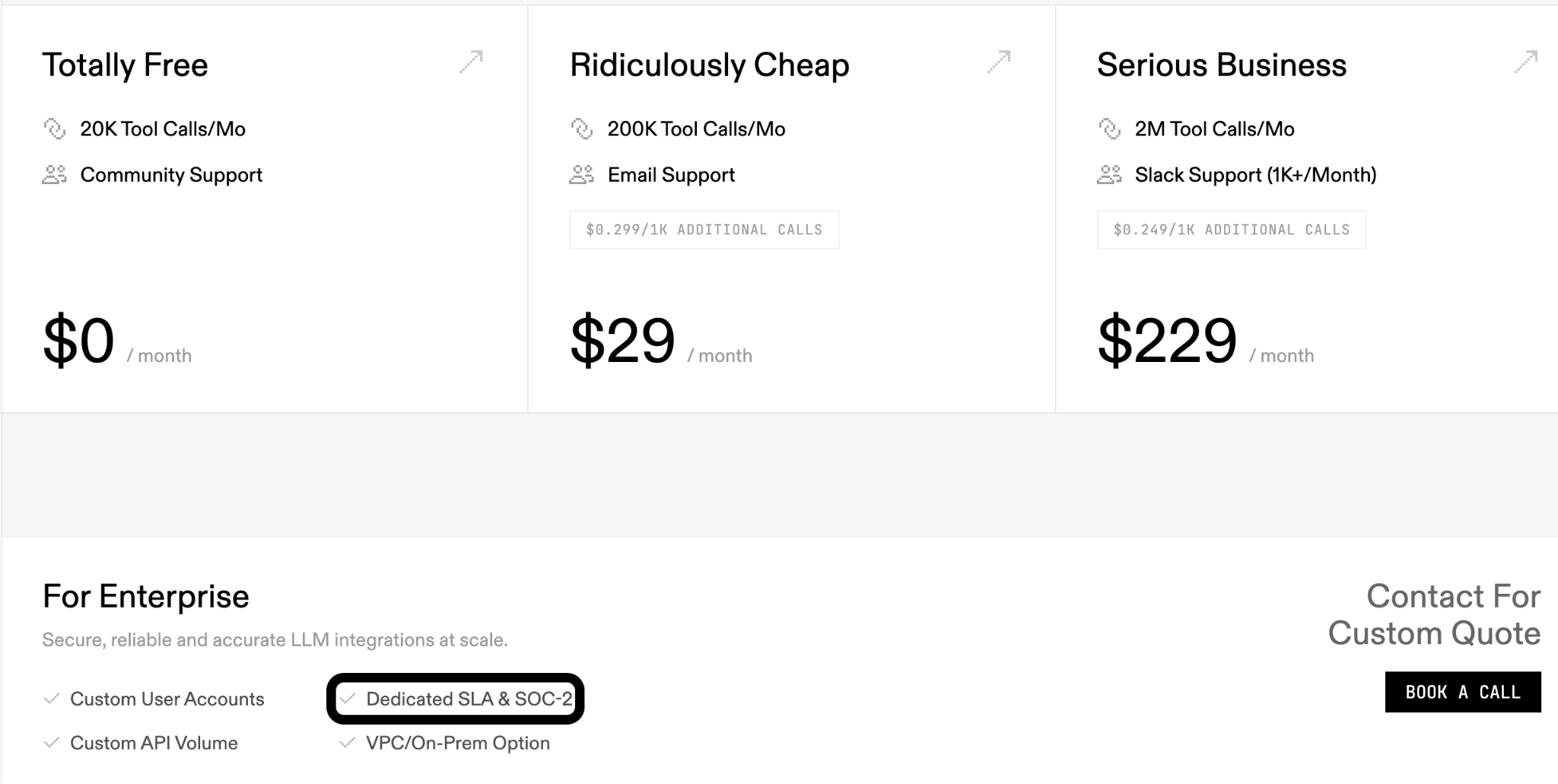
- Inadequate compliance: Composio doesn’t provide SOC-2 on most plans; it’s only available on their “For Enterprise” plan
- Security risks: Composio disclosed a May 2026 security incident where attackers exfiltrated thousands of customer API keys and GitHub OAuth tokens. This triggered Composio to partially shut down their services for several days. If security and reliability top your evaluation criteria, this incident is worth factoring in
{{this-blog-only-cta}}
Arcade overview
Arcade.dev, or Arcade, is an MCP runtime for production agents that focuses on authorization and tool execution as well as providing a registry/marketplace model.
Pros
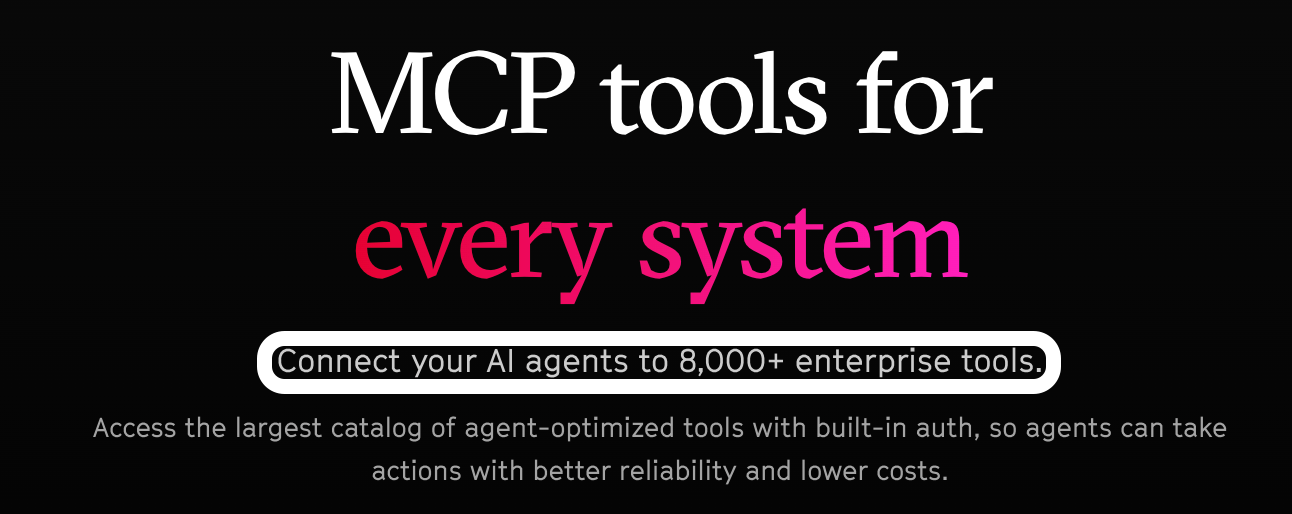
- Broad tool coverage via MCP server registry: Arcade aggregates a sizable catalog across multiple quality tiers, which can help teams get long-tail coverage quickly
- Deployment flexibility: Arcade supports cloud, VPC, on‑prem, and even air‑gapped deployment options, which is valuable for regulated environments
- Recent funding: Arcade recently raised a $60M series A, which will help them move faster in improving their MCP connectors and observability features
Cons
- Tiered catalog quality: Many of Arcade's connectors are community-maintained, and their quality and reliability vary widely. You can end up uncovering significant bugs in these connectors and have to patch them yourself
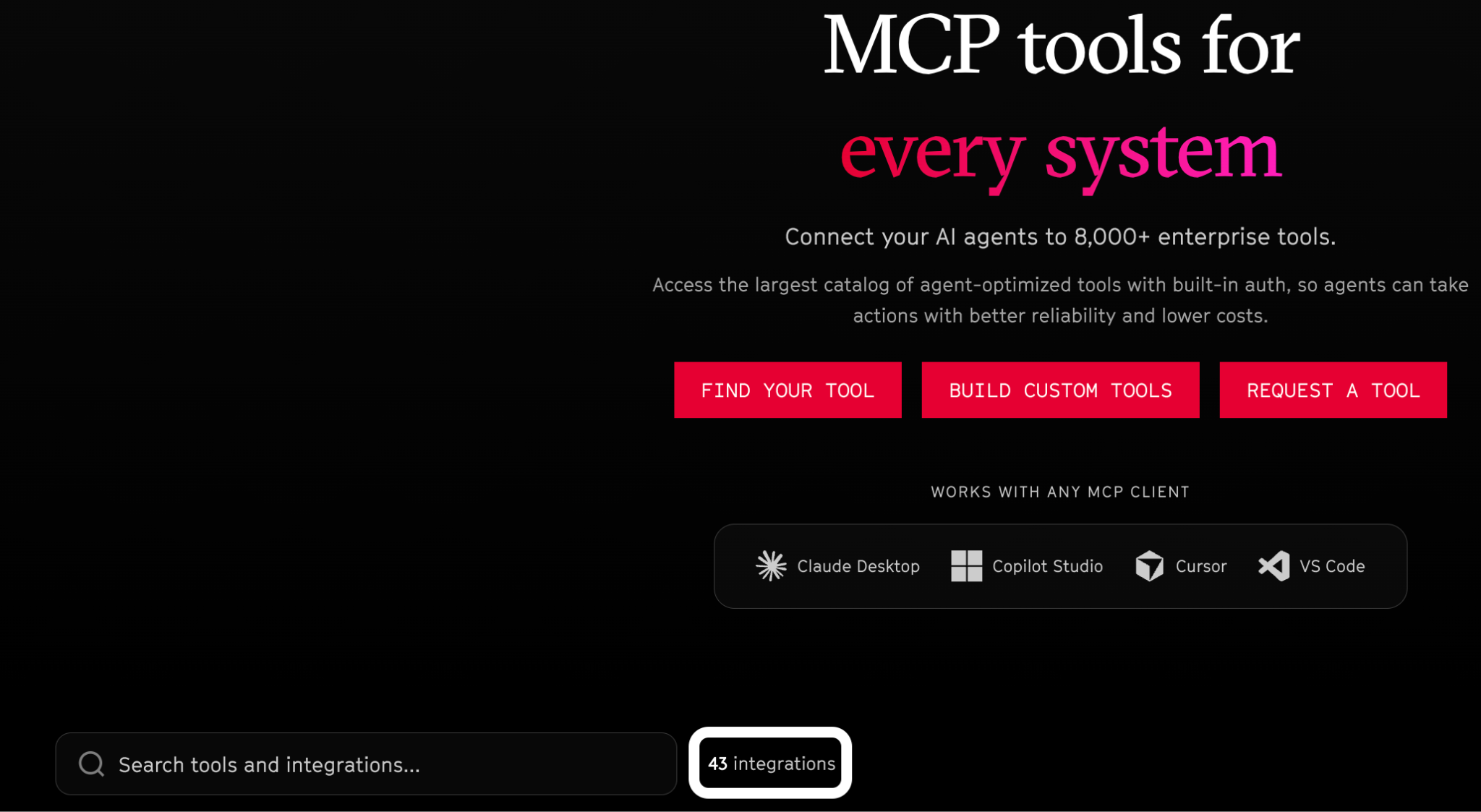
- Minimal set of hosted and maintained connectors: Arcade's team only provides 43 MCP connectors. This means you’ll likely end up using ones from their community
- Governance features are limited on lower plans: Audit logs, RBAC, SSO/SAML, and compliance reporting are gated on their Enterprise plan, which can be a blocker if your team needs these features
Related: Common alternatives to Arcade.dev
Composio vs Arcade
Given all the pros and cons of each platform, it can be hard to choose between them. Here are two general rules of thumb that can help:
- Use Composio if you need broad SaaS coverage fast (1,000+ apps) and agent-native execution primitives like sessions, triggers, and sandboxes in a code-centric stack. Just weigh that against its thinner governance controls, questions around its SOC 2 scope, and the May 2026 security incident if compliance and reliability are top priorities
- Use Arcade if you need flexible deployment for regulated environments (cloud, VPC, on-prem, or air-gapped) and session-based, scoped authorization. But prepare to vet or patch connectors beyond its ~40 first-party MCP connectors
Why Merge Agent Handler is the best alternative
Merge Agent Handler connects AI agents to enterprise tools through production-ready, fully-maintained MCP connectors, with authentication, security, and observability built in.
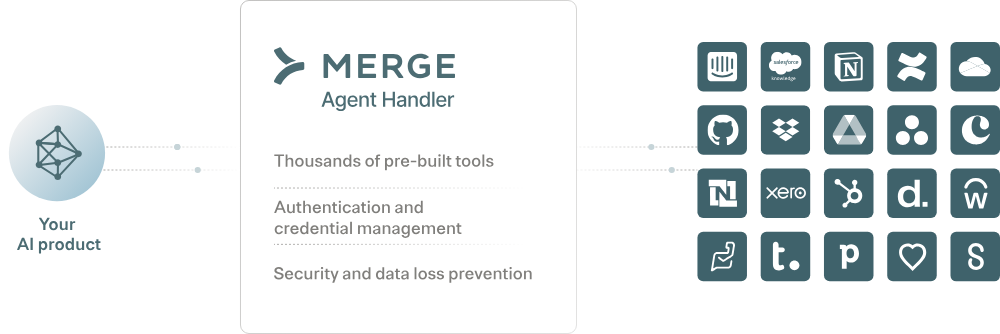
Agent Handler addresses all of Composio's and Arcade's drawbacks by offering:
- Governance-first controls: All plans come with features like policies that define the data agents can access and share, along with alerts that let your team monitor policy violations
- Managed, production-grade connector reliability: They’re designed around clearer ownership expectations and enterprise readiness, rather than depending on a marketplace mix that includes auto-generated or community-maintained servers
- Enterprise identity and lifecycle: If you’re rolling out AI internally, Agent Handler for Employees lets you incorporate user lifecycles, access ceilings, and clean offboarding so that data stays secure
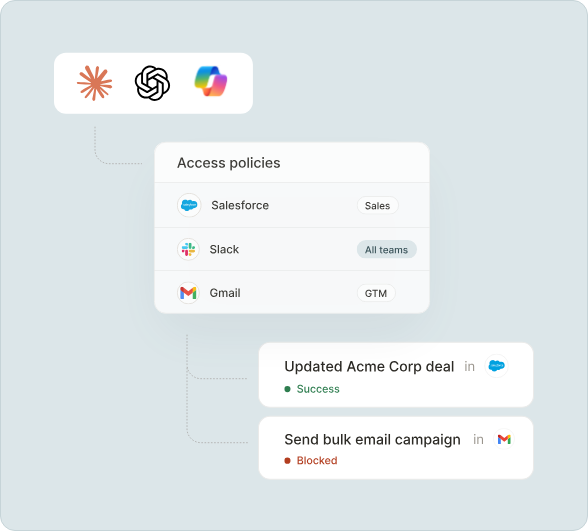
- Enterprise-grade security for every customer: Agent Handler provides scoped tool access, DLP guardrails, RBAC, and searchable audit logs on every plan. Each also maintains SOC 2 Type II, ISO 27001, HIPAA, and GDPR compliance
{{this-blog-only-cta}}
Jon Gitlin
.png)
.png)

Don't settle for Composio or Arcade
Leading AI companies like Perplexity use Agent Handler to securely connect their agents to thousands of tools.


But Merge isn’t just a Unified
API product. Merge is an integration platform to also manage customer integrations. gradient text
But Merge isn’t just a Unified
API product. Merge is an integration platform to also manage customer integrations. gradient text
But Merge isn’t just a Unified
API product. Merge is an integration platform to also manage customer integrations. gradient text
But Merge isn’t just a Unified
API product. Merge is an integration platform to also manage customer integrations. gradient text