

Table of contents
.avif)
.avif)
5 AI agent statistics to help you build agents in 2026


Jon Gitlin
As you think through the best ways to build your agents, you’ll need to navigate several areas.
- Picking the agent connectors to adopt first
- Deciding whether to start with internal or customer-facing agents
- Choosing if and how to use the Model Context Protocol (MCP)
- And more!
To help you make these decisions successfully, we’ll walk through several insights from our 2026 state of agentic integrations report.

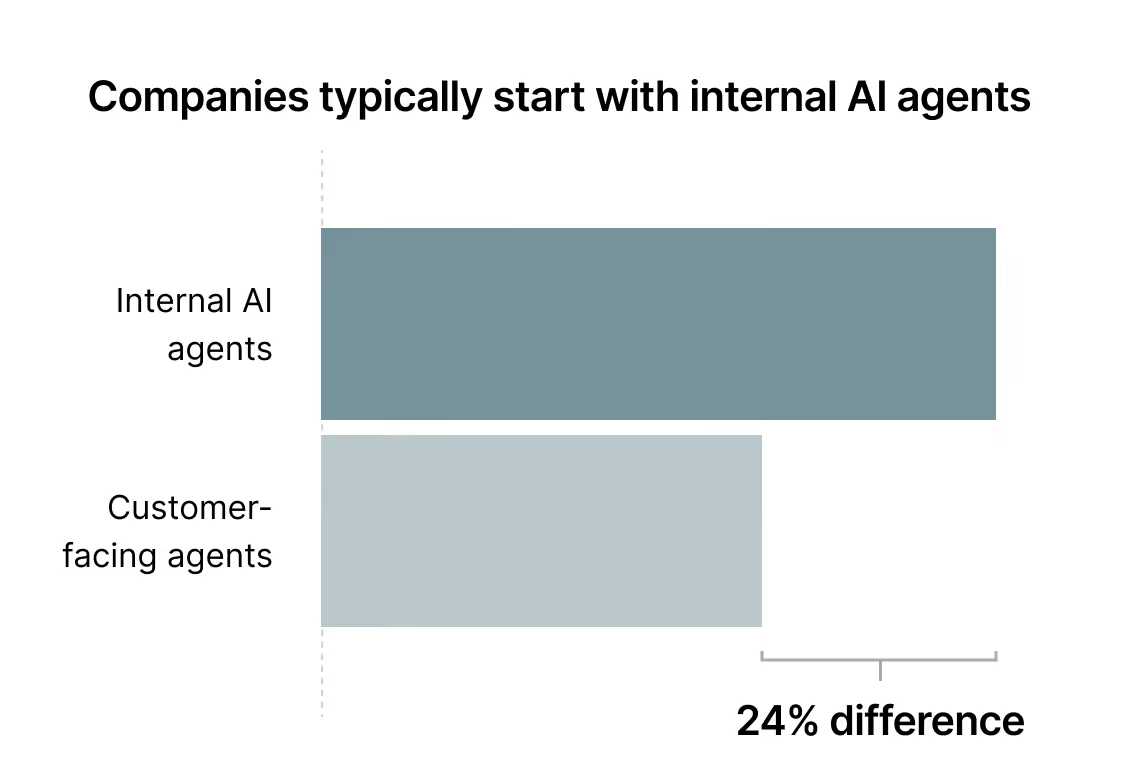
1. Companies are 24% more likely to build internal agents than customer-facing ones
An internal agent, which works within your businesses’ applications, data, and teams, is significantly more popular than a customer-facing agent, which works within your products and your customers’ applications.
The reason might come down to the value business executives already see from leveraging internal agents.
According to a recent study by PwC, 75% of business executives believe agents will reshape the workplace more than the internet did. That’s motivating nearly all business executives (88%) from the study to open up additional budgets for internal AI initiatives over the coming months.
2. 73% of companies will build agentic integrations with MCP servers in 12 months
Forty three percent of companies already connect their agents to MCP servers, and another 53% said they’ll do so within the next 12 months.
Taken together, a whopping 73% of companies will use MCP by the end of 2026.
Even more surprising, 79% of the companies who have concerns and see challenges with using MCP servers will still use it within the next 12 months.

This highlights that there aren’t suitable alternative approaches for connecting AI agents with 3rd-party software.
3. 75% of companies will outsource their integrations with MCP servers
Most companies that plan to build MCP integrations will outsource them.

The leading reason behind this line of thinking? Security.
Seventy two percent of companies said that MCP servers’ security risks—like credential leaks, malicious servers, and tool-poisoning—require specialized expertise to address.
The difficulty in building MCP integrations is another key factor: 70% say that implementing authentication, error handling, and normalized data models requires significant technical expertise.
Related: The benefits of using hosted MCP servers
4. 66% of companies will integrate their agents with chat platforms
The value of your agents depends on their ability to work where your customers and colleagues are.
Case in point: Companies are prioritizing agentic integrations with chat platforms (which include applications like Microsoft Teams and Slack).

That said, systems of record, like CRMs (e.g., Salesforce) and knowledge management systems (e.g., Notion), are also in high demand, underscoring the importance of giving your agents accurate and comprehensive context.
5. 81% of companies use MCP to perform targeted lookups in 3rd-party software
Many companies aren’t using MCP to build complicated, multi-step agentic workflows yet.
Their agents are using the protocol to perform relatively simple tasks, whether it’s getting a status update on a ticket, looking up an employee’s email, or confirming whether an invoice got sent.

That said, as companies get more comfortable with using agents within their business and in their products, we expect more of them to use MCP for complex agentic workflows.
Final thoughts
Some of these stats may be helpful in informing your strategy with agents, while others won't. It just depends on the types of agents you’re building.
But if you can use these insights alongside other research to guide your decision-making process, you’re more likely to end up with agents that give your business and your product a competitive advantage.
{{this-blog-only-cta}}
Jon Gitlin
.png)
.png)

Access all of our research
Download the full report to see how companies currently and plan to build and maintain integrations with their agents.


But Merge isn’t just a Unified
API product. Merge is an integration platform to also manage customer integrations. gradient text
But Merge isn’t just a Unified
API product. Merge is an integration platform to also manage customer integrations. gradient text
But Merge isn’t just a Unified
API product. Merge is an integration platform to also manage customer integrations. gradient text
But Merge isn’t just a Unified
API product. Merge is an integration platform to also manage customer integrations. gradient text