


Merge vs Composio: when to choose one over the other


Tim Bourcier
As your AI agents start taking action in your customers' tools, you'll need integrations that keep authenticating and keep returning the right data, even after a vendor changes its API.
Otherwise, your agents fail in ways your customers notice. A token expires and a user has to reconnect, or a tool returns a success response while quietly ignoring a filter. When an agent writes to the wrong record, you need to be able to trace why.
If you're looking for a platform to handle this, you're likely evaluating Merge Agent Handler and Composio. We'll break down each platform's strengths and weaknesses, share how Agent Handler performs in production, and give you clear rules of thumb for choosing between them.
At a high level, here's how they stack up:
Composio overview
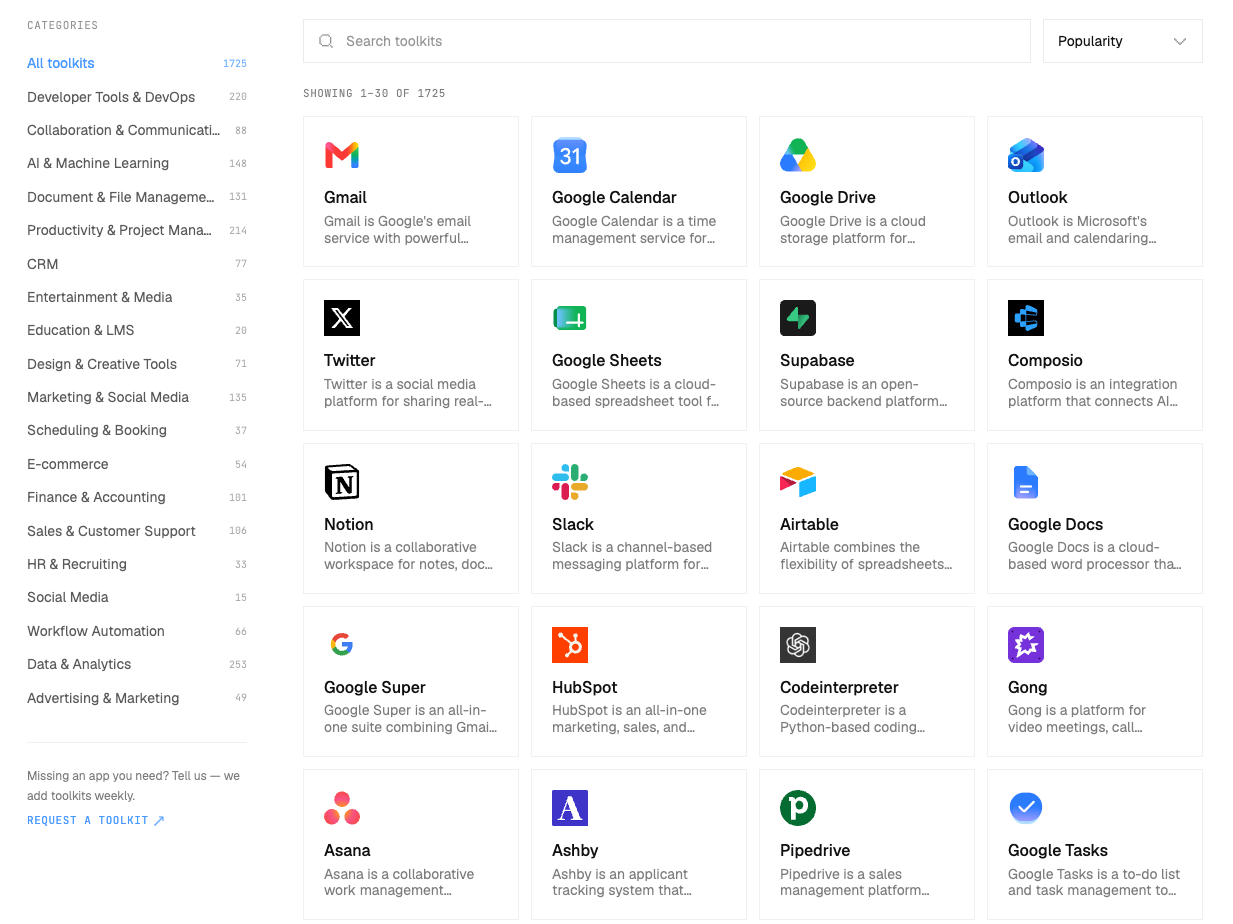
Composio is an integration and tool-calling platform that lets AI agents authenticate to third-party apps and take actions in them through one interface. It pairs a large catalog of prebuilt toolkits with managed authentication, event triggers, session-based configuration and a sandbox for running agent-generated code. Developers can wire it into most agent frameworks through its Python and TypeScript SDKs or connect over the Model Context Protocol (MCP).
Strengths
- Broad connector catalog: Composio advertises more than 1,500 apps, so there's a good chance it lists the long-tail tool you need
- Developer-friendly primitives: You get Python and TypeScript SDKs, adapters for frameworks like the OpenAI Agents SDK and Vercel AI SDK, and dynamic tool discovery within a session
- Event-driven workflows: Triggers send signed webhook events to your app when something happens in a connected app, which suits agents that need to react rather than wait for a prompt
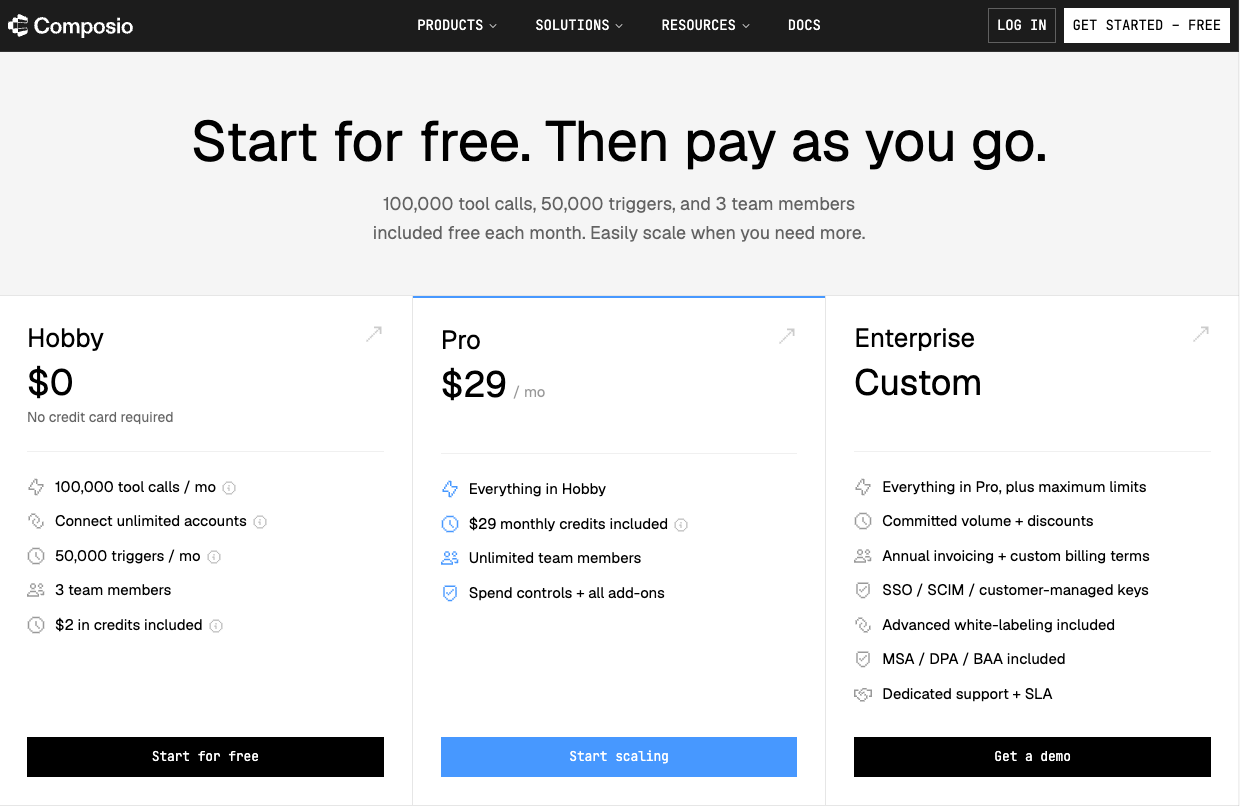
- Low-cost starting point: The free Hobby plan includes 100,000 tool calls a month, and the Pro plan starts at $29 per month
Weaknesses
- Uneven connector depth: A catalog this large mixes deep connectors with thin ones, so you'll need to validate each action, its auth behavior and its error handling yourself before you rely on it
- Many usage meters: Costs can vary by tool calls, calls on Composio-managed apps (priced by app), triggers, execution mode and add-ons like Firewall, which makes spend harder to forecast as you scale
- Policy enforcement relies on natural language: Composio's Firewall evaluates requests against natural-language policies, so you'll want to test how consistently it blocks what it should and allows what it should
- Enterprise controls sit on the top tier: SSO, SCIM provisioning and private VPC deployment are all Enterprise-only
Related: 3 Composio alternatives to consider in 2026
Merge Agent Handler overview
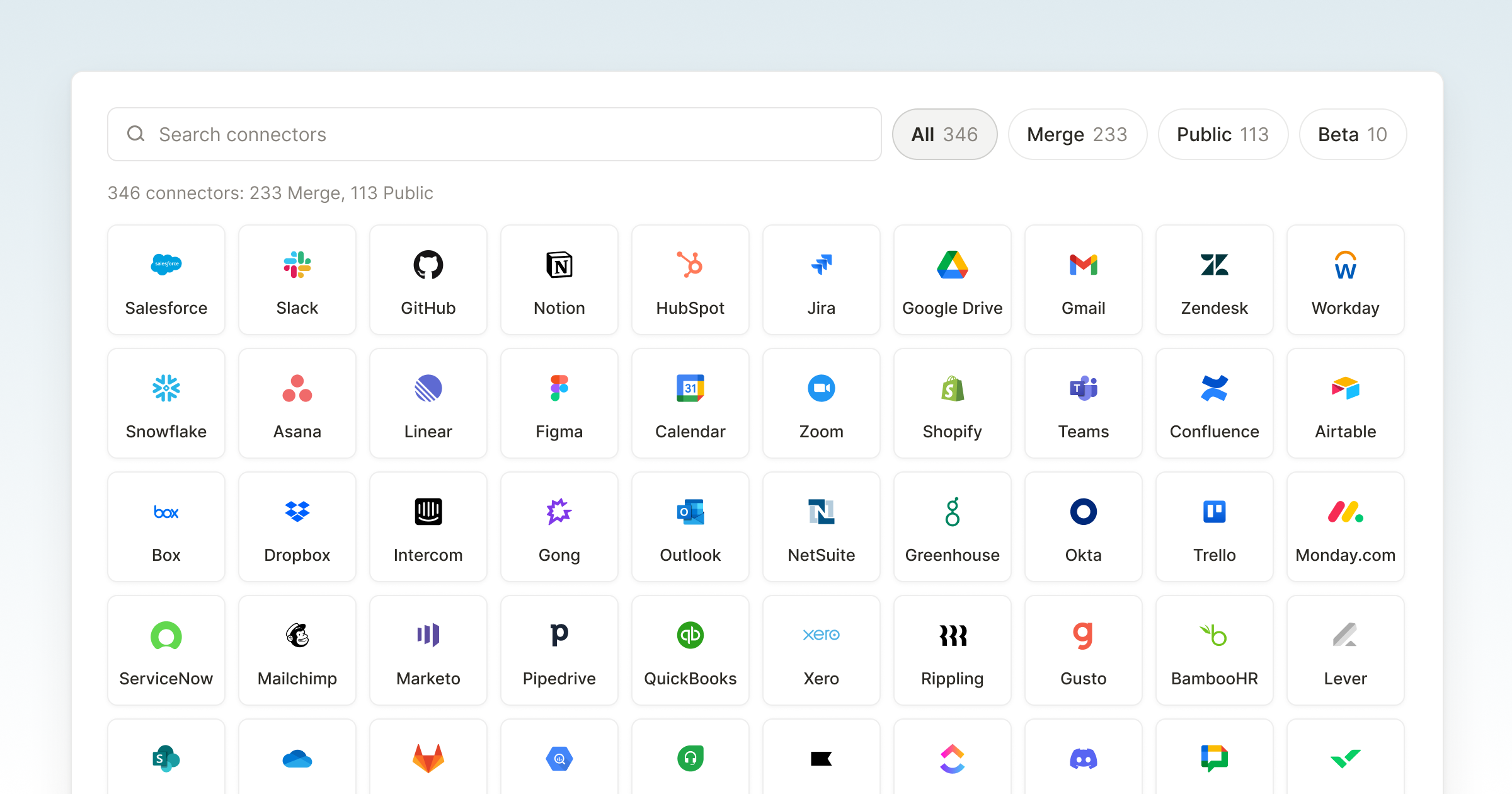
Merge Agent Handler is a tool-calling platform that gives your AI agents production-ready MCP connectors to the third-party tools your customers use. Merge tests connector behavior against real vendor APIs, and the catalog marks which connectors Merge builds and which come from outside vendors. Agents call tools in real time through MCP, so it works with any agent framework and with MCP clients like Claude, Cursor and ChatGPT. Around those connectors sits the credential management and access control you need once your agent becomes a product customers depend on.
Strengths
- Tested connectors with clear ownership: The catalog marks which connectors Merge builds and tests and which come from outside vendors, and Merge runs thousands of live tests against real vendor APIs every month
- Reliable credential handling: Agent Handler refreshes OAuth tokens before they expire, locks refresh tokens so concurrent calls don't collide, and tells you when a grant is revoked or expired so you know which app the user needs to reconnect
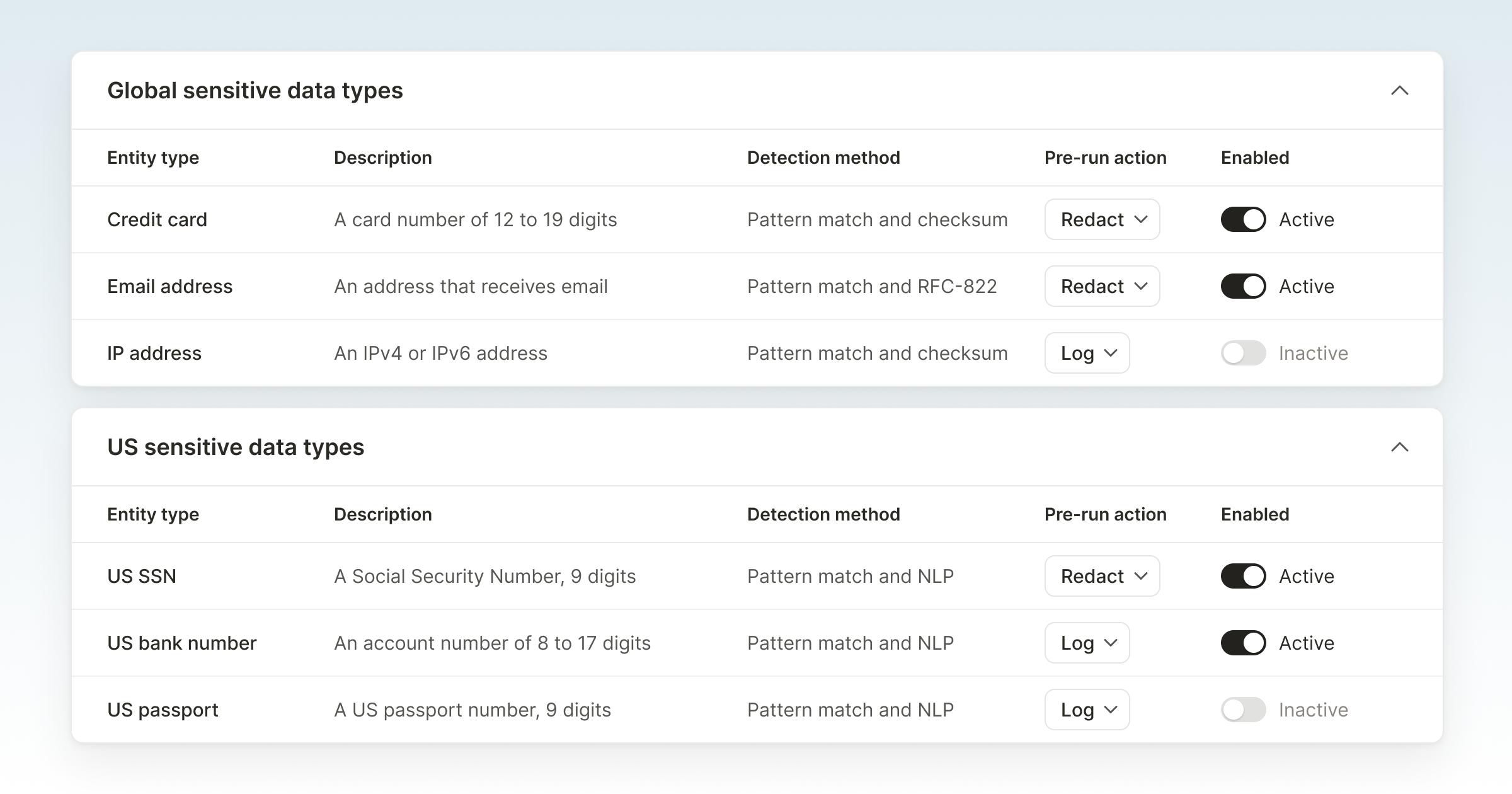
- Reusable security policies: Tool Packs control which tools each agent can use, and security rules set once for your organization allow, block or redact sensitive data, with overrides per Tool Pack
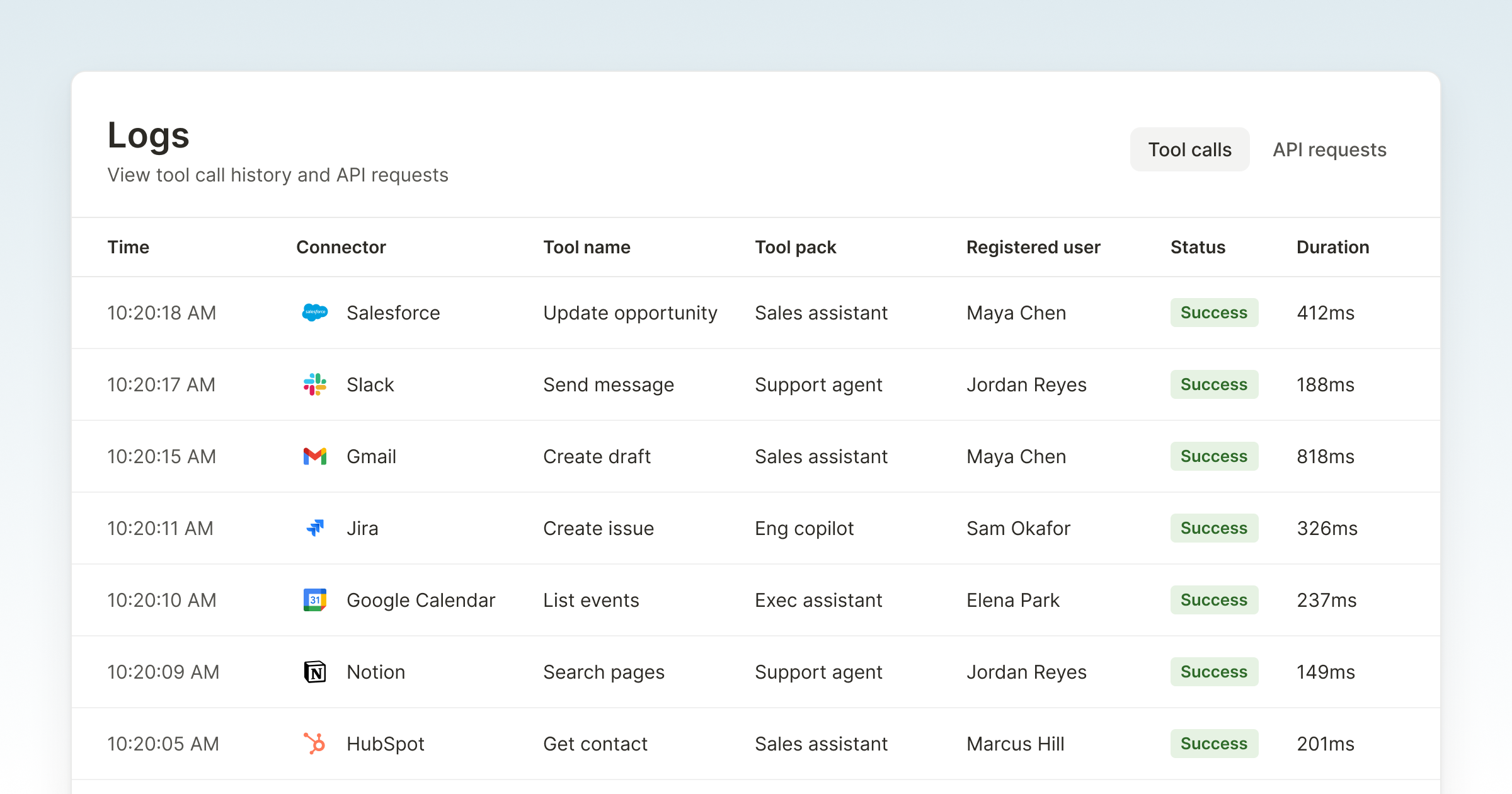
- A full record of every request: Tool call logs, API request logs, rule violations and the admin audit trail are kept as separate views, so you can tell what the agent asked for, what Merge sent upstream and which rule fired
Weaknesses
- Smaller catalog: Agent Handler covers fewer apps than Composio, so check that the connectors you need are listed (or ask about a custom build on Enterprise)
- Higher paid entry point: After the free plan, Pro starts at $1,000 per month because it's priced for production workloads, so it's more than a side project needs
- Fewer event-driven features: Agent Handler focuses on real-time actions, so if your agent depends on running generated code or reacting to webhooks from connected apps, Composio offers more out of the box
How Merge Agent Handler performs in production
A catalog count says little about how connectors behave when thousands of agents call them every day, so here's what Agent Handler's production data shows.
Usage is growing fast across many teams
Monthly tool-call volume on Merge Agent Handler grew 450% over the last 90 days. In the latest month alone, tool calls more than tripled, and they nearly tripled even with the three largest customers removed.
When a vendor's API fails, your agent knows why
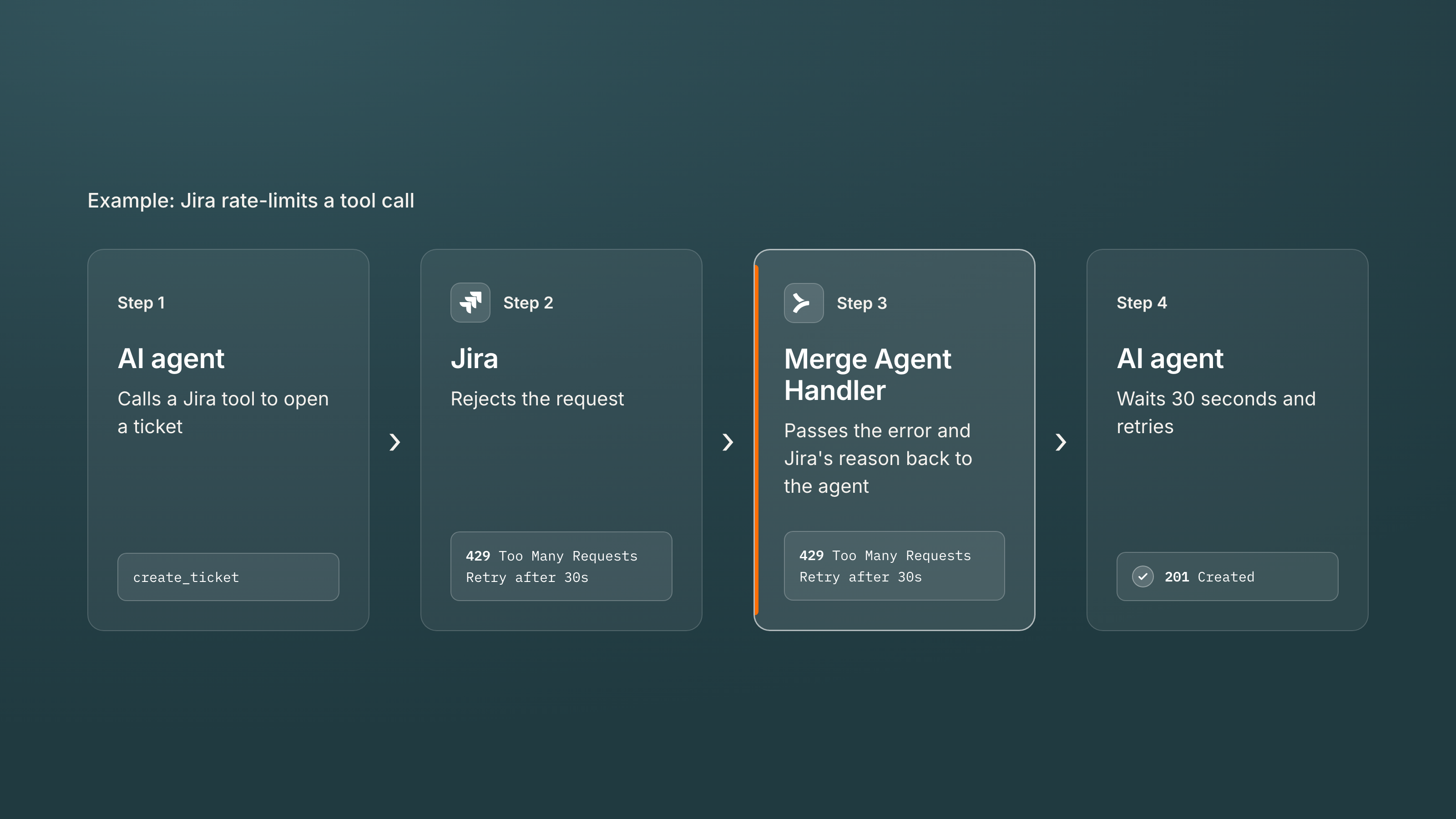
Third-party APIs time out, rate-limit requests and reject bad input. Agent Handler returns a clear, specific error to the agent each time, so the agent can recover instead of failing silently.
- Vendor errors come back with the vendor's reason: When a vendor's API returns an error, Agent Handler passes the vendor's message back so the agent can retry or adjust the call
- Bad arguments get an error the agent can act on: When an agent sends invalid arguments, it learns what to fix instead of getting an empty or misleading response
Credentials stay connected
Only 0.3% of OAuth token refreshes ever require a user to reconnect. Agent Handler refreshes most tokens just before a tool call, so the call goes out on a fresh token and your users don't get pulled back into a login screen.
Connectors are tested against real APIs
A tool can return HTTP 200 and still ignore a filter or save nothing. Merge tests connector behavior against real vendor APIs: almost 12,000 test cases across more than 4,000 tools.
Mocked unit tests can't catch an API that behaves differently from its docs. In Merge's data, 43% of connector fixes addressed exactly that kind of mismatch, and every one had passed mocked unit tests. Live tests are how Merge finds them. In all 17 internal comparisons, Agent Handler matched or beat the vendor's own MCP server on answer correctness.
Related: How to test your AI agents
Vendor access is already handled
About 30% of Agent Handler connectors need vendor approval, and more than half of those take weeks to get. Merge already has signed agreements with vendors like Workday, NetSuite, Greenhouse and DocuSign. Merge-owned OAuth apps for Gmail, Google Drive, Google Sheets, Google Calendar and Gong also let your customers connect accounts without you registering your own developer app.
Enterprise systems of record are covered
Agents in production often need HR, accounting and CRM data. Merge makes more than 2 billion calls to third-party APIs every week across its Unified API, and those systems bring their own auth. About half of HRIS connections don't use OAuth at all and rely on API keys, SFTP files or credential exchange instead.
Security and enterprise readiness
Both platforms list SOC 2 Type II and ISO 27001 compliance, both support SSO and SCIM provisioning, and both offer private deployment on their Enterprise plans. The differences show up in how each platform stores credentials and enforces policy, and in each vendor's track record.
Composio disclosed a security incident in May 2026. According to its write-up, an attacker got a foothold in an internal agentic tool, escalated access and was able to run arbitrary code in Composio's tool-execution sandbox. Composio reports that about 0.3% of active connections leaked, including 5,001 GitHub connections, and that a cache service the attacker likely had access to held 5,241 API keys. In response, it rolled credentials (including encryption keys), deleted all API keys created before May 22, 2026, revoked all user GitHub tokens and contacted affected customers. In a September 2026 update, it added envelope encryption for OAuth credentials and now stores API keys only as hashes. If you're evaluating Composio, read the disclosure and ask how those changes apply to your deployment.
Whichever vendor you choose, ask where your customers' credentials are stored, how quickly tokens can be revoked and whether policy is enforced before data leaves the tool call. Agent Handler runs DLP scanning on tool-call inputs and outputs, applies allow, block and redact rules set for your organization and adjustable per Tool Pack, and records every rule violation.
Related: How AI agent authentication works
Merge vs Composio
Weighing Composio's catalog size and low entry price against Agent Handler's tested connectors and production controls can make the choice feel close, but a few rules of thumb make the decision easier.
- When to use Composio: You're prototyping, building an individual project or running a smaller deployment. Composio gets you to working tool calls quickly and cheaply, and its triggers and sandbox help if your agent reacts to events or runs generated code. You'll just need to validate each connector you rely on and plan for more operating work as usage grows
- When to use Merge Agent Handler: You're shipping agents to enterprise customers, and those integrations have to hold up at production scale. Merge tests its connectors against real vendor APIs, keeps OAuth connected for every end user and logs every tool call, so your team isn't left maintaining integrations. You also get the controls enterprise security teams ask for: DLP scanning, rules that block or redact sensitive data, full audit logs on every plan and several hosting options on Enterprise, including on-prem
Don't settle for connectors you have to test and babysit yourself. Get started with Merge Agent Handler for free and give your agents connectors that are tested against real vendor APIs and credentials that stay connected. Sign up for free.
Merge vs Composio FAQ
Does Merge Agent Handler sync data in batches or act in real time?
Agent Handler acts in real time. Agents call tools through MCP, and every tool call makes a fresh call to the vendor's API with the user's stored credentials. Merge's Unified API is a separate product that syncs normalized data from systems like HRIS and accounting platforms, and you can use it alongside Agent Handler when your agent needs that data.
Which has more connectors, Merge or Composio?
Composio advertises a larger catalog. Agent Handler's catalog marks which connectors Merge builds and tests against the real vendor API and which come from outside vendors. If you need a niche tool, check both catalogs. If you need a common tool to work reliably in front of customers, compare how each one is tested and maintained.
How do Merge and Composio handle OAuth and credentials?
Both manage OAuth for you. Agent Handler refreshes access tokens before they expire, and when a grant is revoked or expired, the tool call tells you why so you know which app the user needs to reconnect. By default, it uses Merge's own OAuth apps, so you don't have to register a developer app for each connector.
Can I deploy Merge or Composio in my own cloud?
Yes, on both platforms' Enterprise plans. Composio offers private VPC deployment and self-hosting. Agent Handler's Enterprise contracts can include single-tenant hosting, EU and APAC data residency, VPC peering and on-prem deployment.
How do Merge and Composio compare on security?
Both list SOC 2 Type II and ISO 27001 compliance, support SSO and SCIM, and offer private deployment on Enterprise plans. Composio disclosed a security incident in May 2026 that exposed some customer connections and API keys, and it has published the fixes it made since. Agent Handler adds DLP scanning on tool-call inputs and outputs, rules that block or redact sensitive data, and a record of every rule violation.
How does Merge Agent Handler pricing compare to Composio pricing?
Both have a free plan. Composio's Pro plan starts at $29 per month with metered usage on top, and costs vary by tool calls, managed-app calls, triggers and add-ons. Agent Handler's Pro plan starts at $1,000 per month for production workloads and includes a monthly allowance of credits. Both offer custom Enterprise pricing.
Do Merge and Composio work with Claude, Cursor and other MCP clients?
Yes. Both expose tools over MCP. Agent Handler installs as a remote MCP server in clients like Claude, Cursor and ChatGPT, and it works with any agent framework that supports MCP.
How do I switch from Composio to Merge Agent Handler?
Start by listing the tools your agents call today and confirming each one exists in Agent Handler. Then group them into Tool Packs with the rules you need, and have users connect their accounts through Agent Handler. Moving one connector at a time lets you compare results before you cut over fully.
Tim Bourcier




Ready to try the best Composio alternative?
Create a free Merge Agent Handler account and connect your AI agents to thousands of enterprise tools, with authentication, security and observability built in.


But Merge isn’t just a Unified
API product. Merge is an integration platform to also manage customer integrations. gradient text
But Merge isn’t just a Unified
API product. Merge is an integration platform to also manage customer integrations. gradient text
But Merge isn’t just a Unified
API product. Merge is an integration platform to also manage customer integrations. gradient text
But Merge isn’t just a Unified
API product. Merge is an integration platform to also manage customer integrations. gradient text