

.avif)
Introducing the new Merge


Shensi Ding
We accidentally built the foundational infrastructure layer that production AI needed before the market saw it coming.
We started Merge with our Unified API to solve fragmentation across the SaaS ecosystem, giving companies a single API to access hundreds of integrations across major software categories.
And we did. Today, tens of thousands of companies rely on Unified to simplify customer facing integrations, including Ramp, OpenAI, and Dropbox.
But in 2023 and 2024, we saw where the market was heading and made an aggressive decision to invest in how Merge could create value in an AI-driven world. Today, that decision has accelerated our growth and made Merge foundational to the world’s largest and fastest-growing AI labs and companies.
The AI wave exposed an infrastructure gap
As teams built AI products, they hit walls we recognized immediately. The proof of concept looked great, but going to production introduced a completely different set of problems.
For AI to be useful, it needed access to the systems where work actually happened. Models needed reliable access to business data and the ability to interact securely with third-party applications.
But production AI also had to adapt to the way customers actually operate. Every customer wants something different: different models, different integrations, and different tradeoffs around cost, latency, reliability, and control.
We started thinking through the gaps emerging in the AI ecosystem.
The answer kept coming back to three things.
1. AI needs synchronized business context
Customer-facing AI products are only as useful as the business context they can access. High-quality semantic search, retrieval, copilots, and deterministic workflows all depend on structured, up-to-date data from the systems businesses actually use.
That requires reliable integrations, normalization, ongoing sync infrastructure, and correct permissioning across hundreds of third-party applications. ACLs are critical. If permissions are wrong, the product is useless. Merge is the undisputed leader at this, rated #1 on G2. Companies like OpenAI, Mistral, Dropbox, and Freshworks use Unified to power production AI experiences.
2. AI needs flexible, live access to software systems
Many AI workflows require real-time interaction with software systems: making tool calls, retrieving current state, triggering workflows, and interacting with third-party applications directly.
But enabling that safely across enterprise software is difficult. It requires authentication, permissions, credential management, scoping, data redaction, and auditability. That is what Agent Handler is built for.
3. Teams running AI need an AI gateway and control plane
Which model is serving which request? What is it costing per customer, per feature, and per team? What happens when a model or provider goes down at 2 am? Can you enforce customer-specific model requirements? Can you show your enterprise customer an audit trail?
Gateway is built for those production requirements.
How Merge fills that gap
When we looked at these three layers together, we realized “integration infrastructure” had become a much bigger category than we originally set out to build.
That is how we think about Merge today: infrastructure for the parts of production AI that sit around the model.
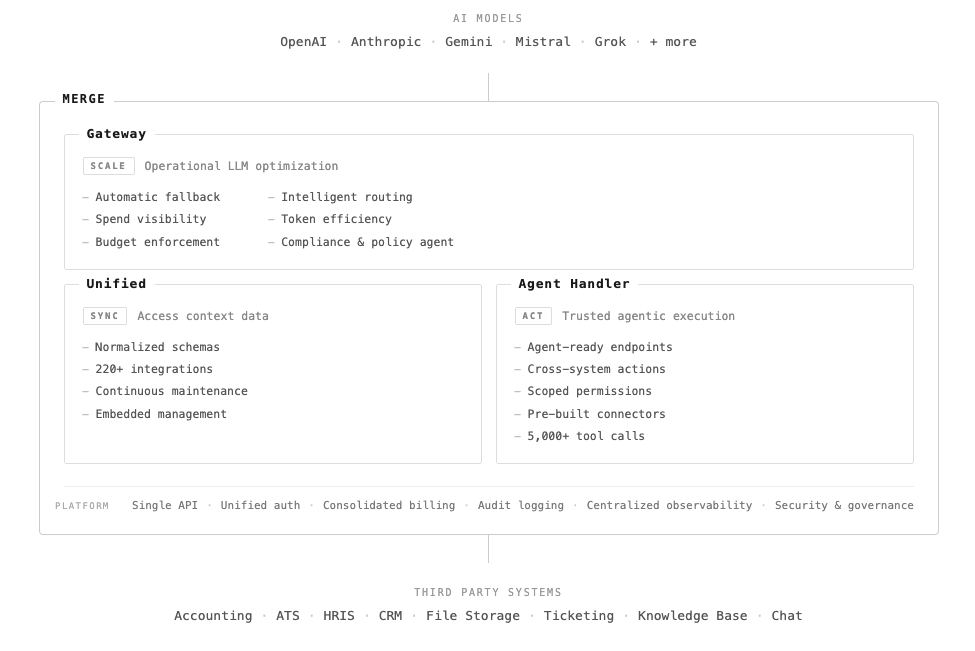
Unified gives AI systems fully synced, structured, and up-to-date business context across hundreds of integrations, with authentication, normalization, and ACLs handled correctly.
Agent Handler gives AI systems flexible, live access to software systems through secure tool calls, with credential management, permissions, scoping, and auditability built in.
Gateway gives teams a model control plane: one API for LLMs, with routing, fallback, cost controls, security policies, and request-level visibility.
All products are built around the same thesis: production AI needs infrastructure around context, tools, and models. Merge handles that infrastructure so teams can focus on building the AI.
Final thoughts
The companies building the most ambitious AI products understand that reasoning can only take you so far.
AI needs access to customer data, the ability to take secure actions, and an AI gateway and control plane to handle model routing, monitoring, governance, costs, and scale.
Unified was our first answer to that problem.
Agent Handler and Gateway are the next ones.
Together, they represent the infrastructure layer we believe every production AI company will need: data access, action execution, and model control.
See it for yourself and start building for free.
Shensi Ding
.png)
.png)


But Merge isn’t just a Unified
API product. Merge is an integration platform to also manage customer integrations. gradient text
But Merge isn’t just a Unified
API product. Merge is an integration platform to also manage customer integrations. gradient text
But Merge isn’t just a Unified
API product. Merge is an integration platform to also manage customer integrations. gradient text
But Merge isn’t just a Unified
API product. Merge is an integration platform to also manage customer integrations. gradient text