

Table of contents

.png)
How to connect a Stripe MCP to Cursor (4 steps)



Jon Gitlin
You're in Cursor writing the code that talks to Stripe, and you keep leaving the editor to check the API.
What's the exact shape of a PaymentIntent? Which field holds the decline code? What are the valid subscription statuses?
Every answer lives in Stripe or its dashboard, so you tab out to a browser, run a one-off API call, or dig through the dashboard, then carry the answer back into the editor by hand. That round trip breaks your flow, and the value you copied back is only as accurate as your memory of it.
To help your developers query and validate Stripe data without leaving Cursor, we'll show you how to connect Stripe with Merge Agent Handler's Stripe MCP server.
How it works
Merge Agent Handler connects Cursor to the Stripe API through the Merge CLI.
You install the CLI, authenticate once, and run a single setup command from your project root.
That command writes a ## Merge CLI section to your project's .cursorrules file, which tells Cursor's agent when to call merge search-tools and merge execute-tool to reach third-party services.
Merge handles Stripe API key storage and rotation on your behalf, so you never commit a key to your repo or rotate it across environments by hand.
Related: How to use the Stripe MCP in Claude Code
Prerequisites
Before getting started, you'll need the following:
- A Merge Agent Handler account
- Cursor installed
- pipx installed (run
pipx --versionto confirm, or install viapip install pipx) - A Stripe account with permission to authenticate the connector
If you want to connect Merge Agent Handler's Stripe MCP with internal or customer-facing agentic products, you can follow the steps in our docs.
1. Install the Merge CLI
Install the CLI with pipx: pipx install merge-api
Verify it installed correctly: merge --version
2. Log in to Merge
Authenticate the CLI with your Merge Agent Handler account: merge login
This links the CLI to your Merge account and stores your session credentials locally.
3. Connect the CLI to Cursor
Run the following from the root of the project where you want to use Merge tools:
This writes a ## Merge CLI section to .cursorrules so Cursor knows to use the CLI for third-party services. The command is idempotent, safe to re-run if you need to reset the configuration.
Related: The steps for integrating a Stripe MCP with Codex
4. Authenticate Stripe
Open a Cursor chat in your project and try: "Pull a recent PaymentIntent and show me its exact JSON structure so I can write a type for it."
The first time you invoke a Stripe tool, a Magic Link will appear to complete connector authentication.

{{this-blog-only-cta}}
Stripe MCP FAQ
In case you have more questions on setting up and using the Stripe MCP in Cursor, we've addressed several more commonly-asked questions below.
What can you do once the Stripe MCP is connected to Cursor?
With Stripe connected, Cursor can:
- Inspect a real PaymentIntent before writing a parser: pull an actual PaymentIntent so you can see its exact JSON shape, nested objects, and which fields come back null before you write the type that deserializes it
- Resolve exact object and field names: confirm real attribute names like
latest_chargeorpayment_method_details.card.last4so your code references fields that exist instead of ones you guessed
- Pull valid enum values for type definitions: fetch the real values a field can take (charge
status,decline_code, subscriptionstatus) so your types and switch statements match what the API actually returns
- Check expand and pagination behavior before coding a loop: make a paged request to see how
has_more,starting_after, andexpand[]behave so your fetch loop terminates correctly and pulls the nested data you need
- Look up real object IDs to use as fixtures: grab live
cus_,sub_, andprice_IDs to drop into the integration code or tests you're writing instead of fabricating placeholder values
Why use Merge Agent Handler vs. a self-hosted Stripe MCP server?
You can build a self-hosted Stripe MCP server that calls the Stripe API directly.
For a solo developer with a restricted API key and a few endpoints, that's manageable: generate the key, write tool schemas for what you need, and point Cursor at it.
The self-hosted path breaks down once a team shares it.
Stripe keys are sensitive because they reach live payment and customer data, and with a self-hosted setup every developer manages their own. There's no central place to scope which Stripe operations an agent can perform, no audit trail of what was read, and no clean revocation when a key leaks or someone leaves.
Merge Agent Handler adds a managed layer: API key storage and rotation handled by Merge, per-user access scoping so each developer authenticates with their own identity, and full audit logging on every tool call.
For a team running Cursor against a live Stripe account, that's a different operational posture than a key sitting in each developer's local config.
Why connect Stripe to Cursor?
When you're writing code that integrates with Stripe, the hard part isn't the logic, it's getting the API details right. The exact field names, the response shape, the valid enum values, the expand and pagination rules: get any of them wrong and the code compiles but fails against the live API.
Cursor is where you write that integration code, but the answers to those questions live in Stripe.
Connecting the two puts the query capability and the reference data in the same session as the code, so you can confirm a field name or inspect a real response without breaking context. The schema you write matches what the API returns, the first time, instead of after a round of runtime errors.
Can I use Merge' Stripe MCP with my employees?
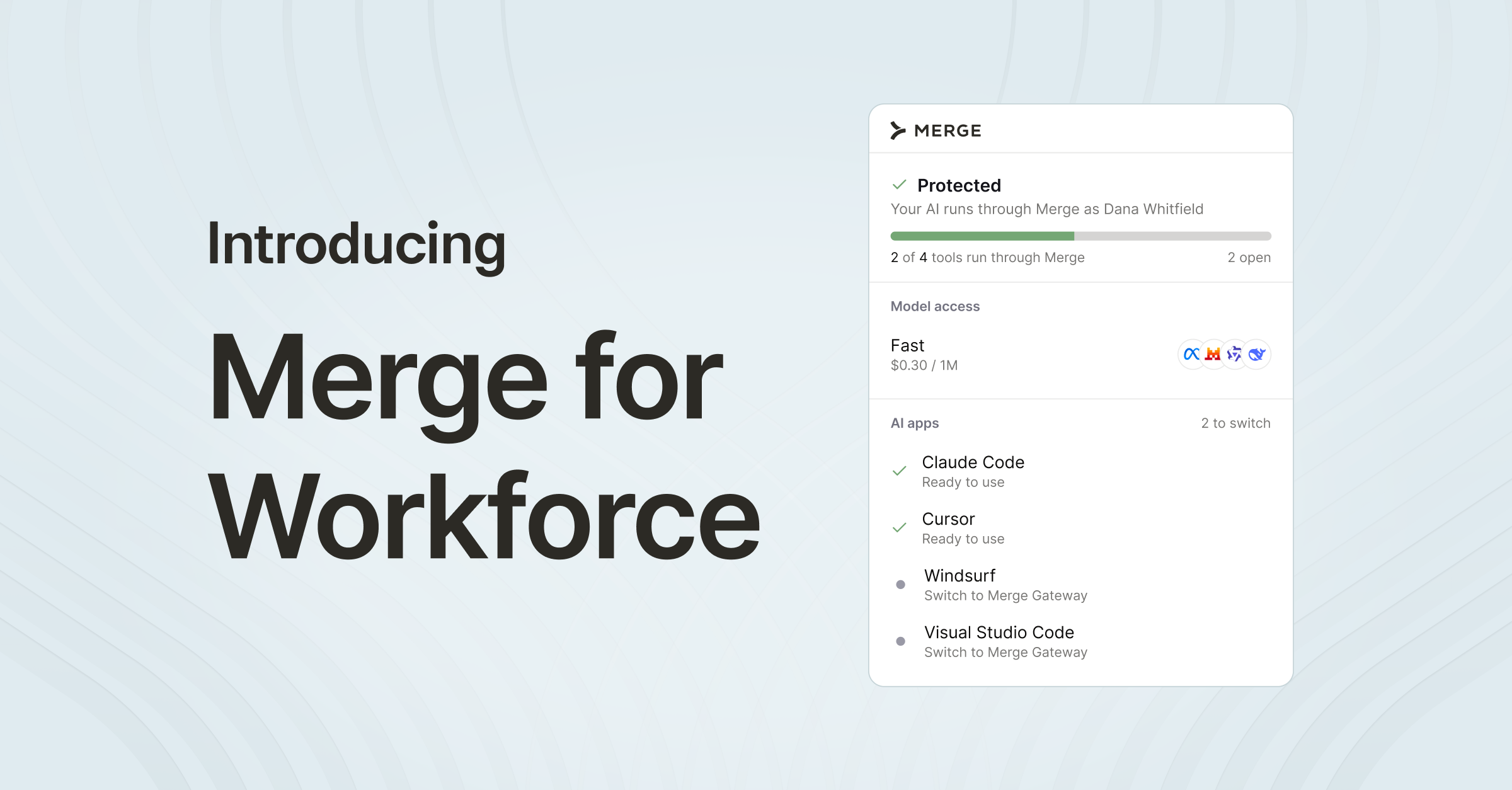
Yes, Merge for Workforce is built to help organizations provision, secure, and govern how employees connect AI tools like Cursor to payment systems like Stripe.
Common patterns include:
- Provisioning and access control via SCIM with identity providers like Okta and Microsoft Entra ID, so IT can manage which employees can reach which Stripe data and operations by role or team
- DLP and policy enforcement on tool calls, so admins can stop an employee's AI from reading live card data or customer PII, or keep it scoped to test-mode data before results reach the sessio
- User-level audit logging so security and IT teams can review which Stripe objects were inspected, which records were retrieved, and which data was accessed, by which employee identity, and when
Put together, employees can use the Stripe MCP to inspect real object schemas, validate field names, pull live enum values, and more, while IT keeps centralized control over which Stripe data and operations each employee can reach.
Jon Gitlin
.png)
.png)

Connect Cursor to thousands of tools with Merge Agent Handler
Use Merge Agent Handler’s 150+ connectors (including Stripe) to power reliable, secure, and powerful agents.


But Merge isn’t just a Unified
API product. Merge is an integration platform to also manage customer integrations. gradient text
But Merge isn’t just a Unified
API product. Merge is an integration platform to also manage customer integrations. gradient text
But Merge isn’t just a Unified
API product. Merge is an integration platform to also manage customer integrations. gradient text
But Merge isn’t just a Unified
API product. Merge is an integration platform to also manage customer integrations. gradient text