

Table of contents
Just for you
No items found.
How I use Merge as a brand systems lead
No items found.
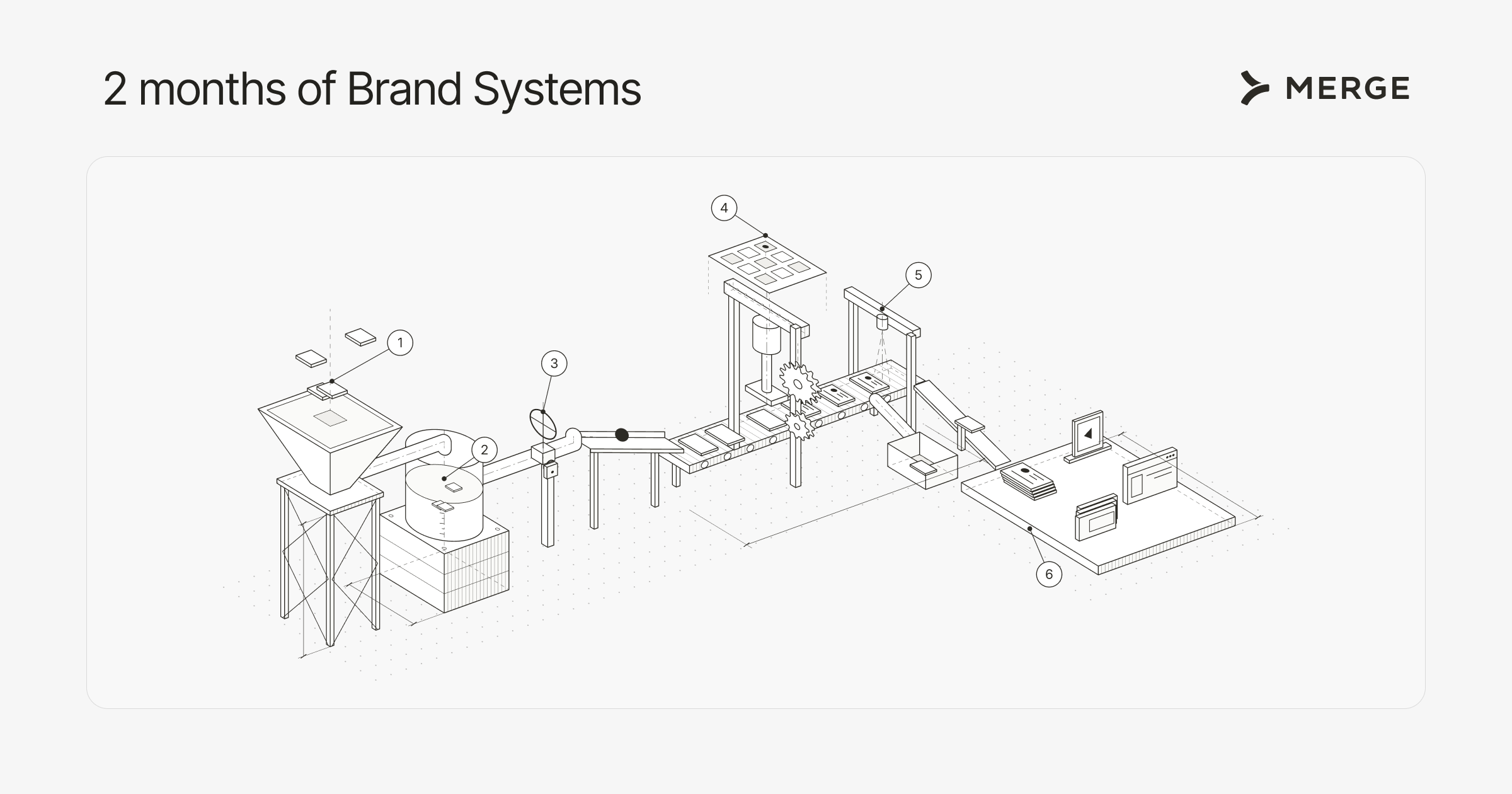
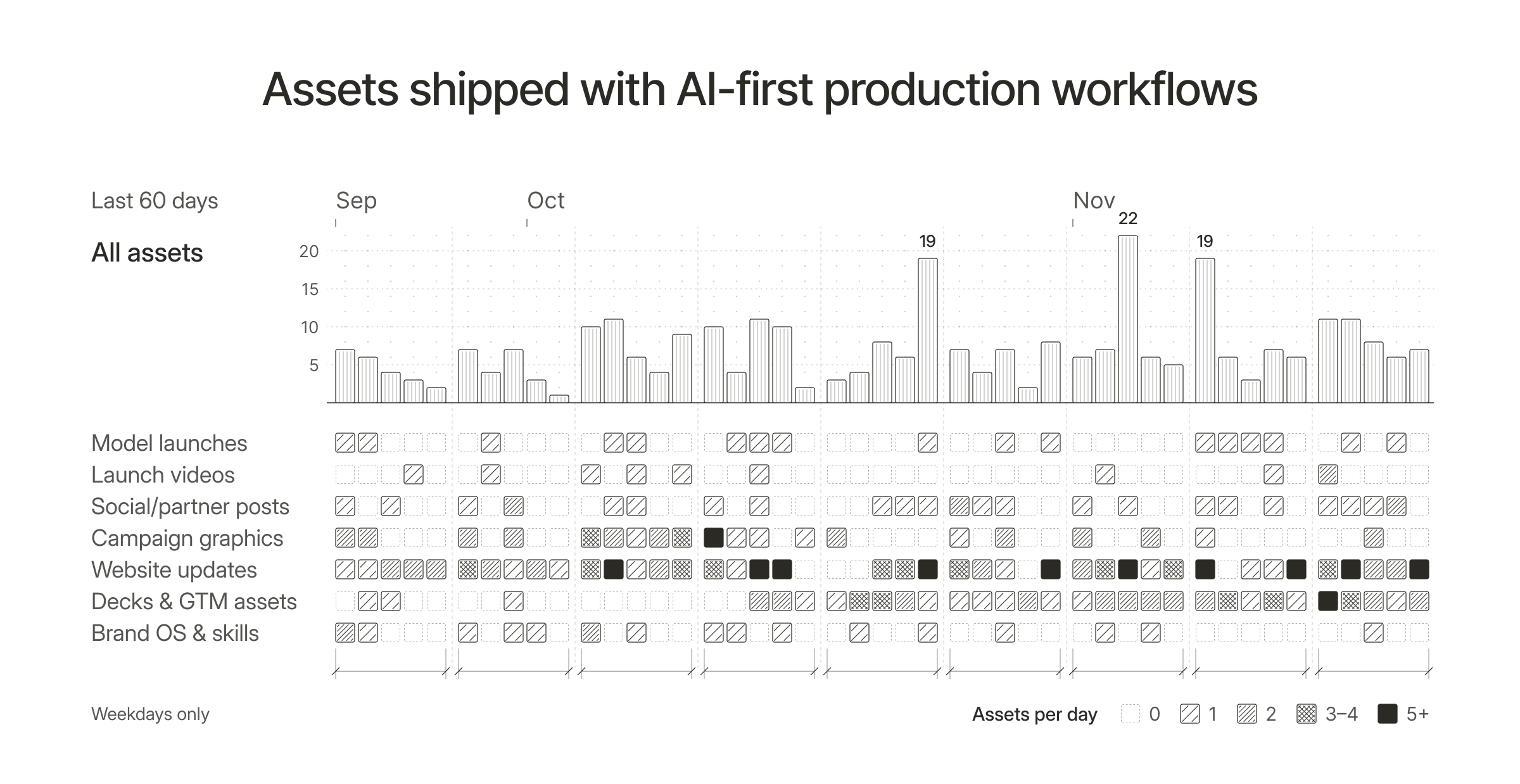
I joined Merge as brand systems lead on September 14. Since then, we've put out launch posts for 19 new Gateway models, around ten launch videos and a steady run of campaign graphics. Every week, more of it comes out of AI workflows the team built. My job is to keep all of it looking and behaving like Merge.
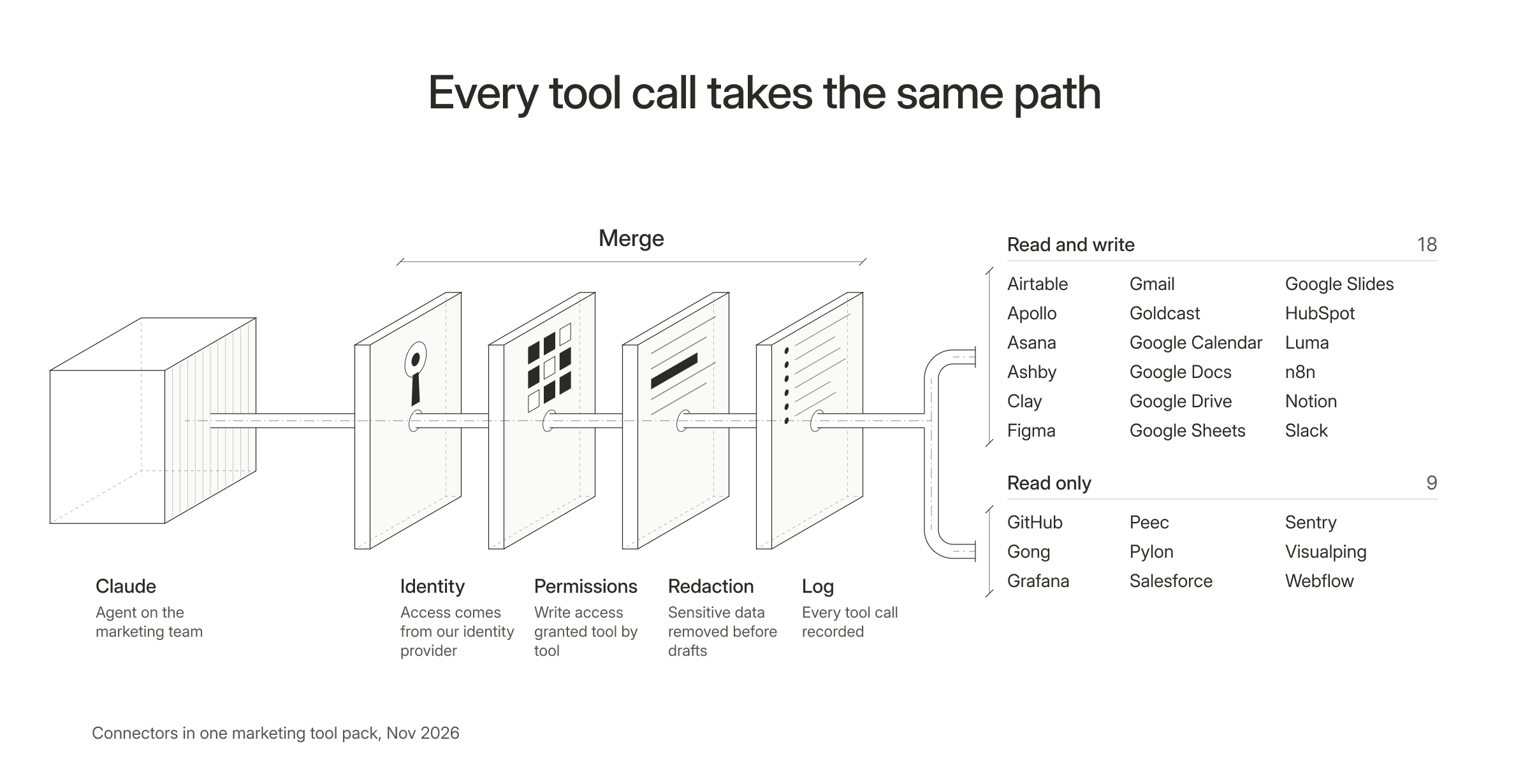
Most of that work runs through agents that access our whole stack.. Claude pulling from internal documentation, plans in Notion, conversations in Slack, web analytics in Webflow, and design files in Figma. Mine has made about 2,200 tool calls since I started.
I've worked at or with four AI companies before Merge, so I've seen a fair range of setups (for a stretch last year I was contracting with two of them at once in SF). This is the first one that feels like luxury AI. We use the same models as everyone else. The difference is that every agent here starts each task with the company's context and access to the tools where the work happens. That's how a brand team this small keeps up with a launch calendar this busy.
Context comes first
A lot of B2B slop taking over the feed comes from a lack of context. Context allows each idea or output to be extremely pinpointed and unique, which in most cases is the antidote to generic slop. Since Merge has a zero tolerance policy for slop, agents begin each task deeply understanding the surrounding context of a project that may inform an important directional decision before the execution phase. With our internal Agent Handler I’ve been able to start with a launchpad into almost any new ask thrown my way, and the rest of the company is able to do this in context of their function. A lot of my own projects that used to open with a 10 minute dictation prompt and handful of pasted docs now kick off from a Slack thread that knows where to find everything else worth factoring in.
Keeping up with launches
A few simple builds changed how we think about launches.
Routine launches usually get the least care. There's always another one next week and the ROI has always been too low to spend hours polishing a video animation. This changed overnight on the release of Opus 5.5 as we refreshed our animation templates and automated the video generation workflow. Since then, we've posted 18 Gateway model launches covering 19 models, plus launches for Agent Handler, Merge for Workforce and our partners. Once the first set of assets existed, we turned the format into a skill. Now the long tail gets the same motion and polish as the big launches, and our team can turn one around the day a model goes live.
A lot of this runs on skills. Our marketing team keeps a library of them, with one for almost every format we ship. Most of it was in place before I joined. I spent my first few weeks refreshing the tokens, composition rules and component library underneath, so every skill draws from the same source. Our internal Universal Context Layer does the rest. Every launch starts from current documentation and positioning instead of a blank prompt.
Decks stay in Slides
A deck usually starts with Claude ideating on context Merge pulls from Notion, Slack, Gong and Webflow. Then Figma for the detailed design. Then back to Google Slides, where our reps actually live.
The biggest test was our main sales deck. It's about 250 slides in Google Slides, and every rep presents from their own copy. A refresh that size is normally a slide-by-slide job. We started by sorting every slide. Most stayed as they were, about 50 needed a refresh, and the rest got merged, cut or sent back to sales with a question. The design work came down to 17 formats instead of 250 slides. Each format got designed once in Figma, and agents rebuilt every slide that used it.
Agents edit the real deck through Merge and compare every changed slide with the last version before calling it done. Our design team reviews in the same file, and their comments become the next round's instructions. The text stays editable for whoever presents it.
One round, Claude tried to redesign everything. We wrote that down too.
Reach we didn't have before
In past roles, a site-wide change meant a ticket for an engineer and a few sprints of waiting.
Here, it's a batch job. In one publish, we cleared 249 duplicate and retired pages out of our sitemap and pointed each one at a live page with a redirect. Our designers prototype new pages in Claude and hand our web agency working code to build from.
RevOps gave me access to the repo behind their personalized account pages. I barely use GitHub. My agent read the onboarding thread and had the pages running on my laptop the same day. Two review rounds with our CEO later, the restyle is a pull request against production.
That's normal here. We track code changes from non-engineering teams at Merge, and the line keeps going up.
Keeping the quality up
Fast output is the easy part now. Most of our attention goes to quality.
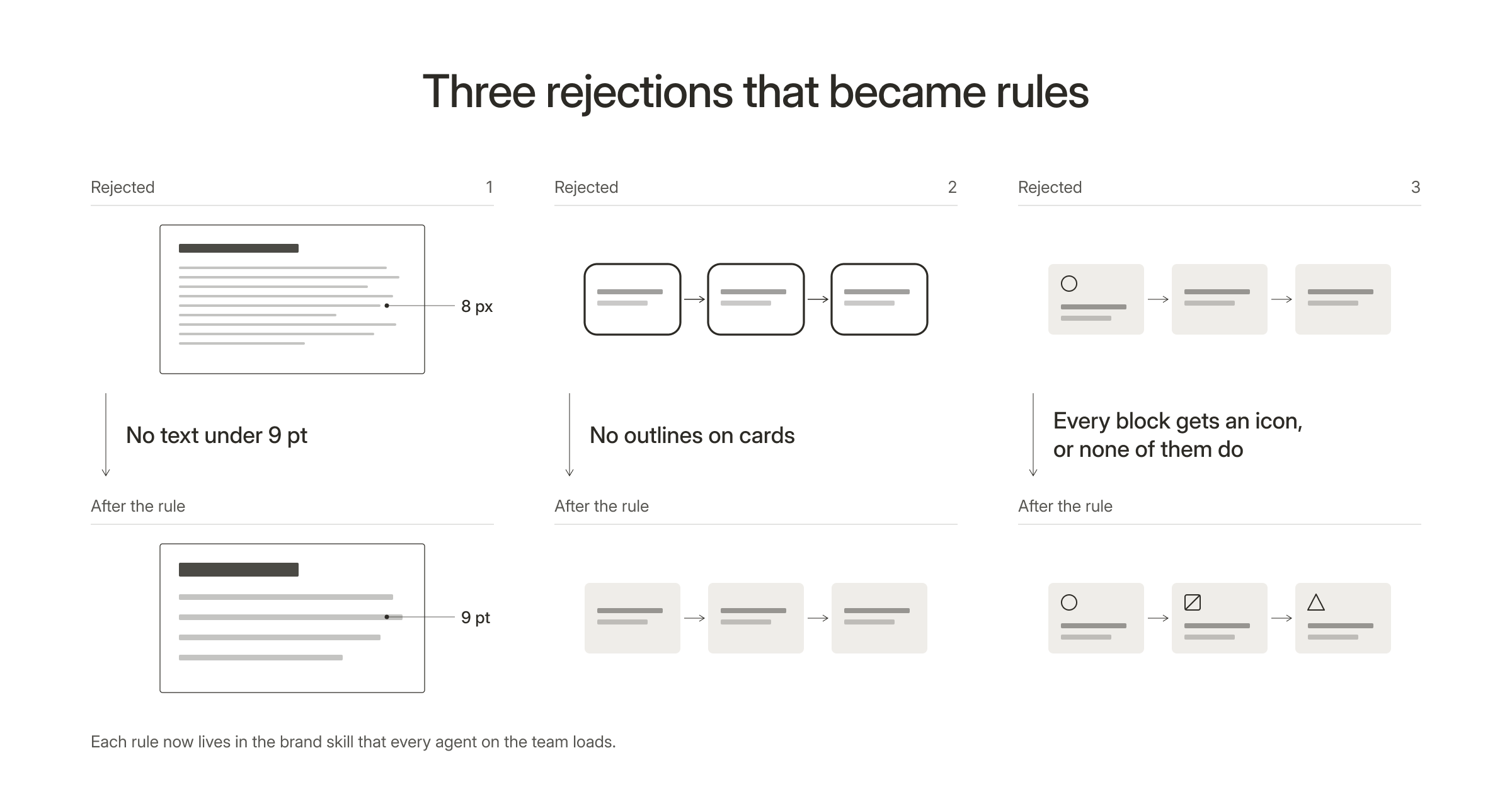
Every time we reject a piece of AI work, we write down why. A deck round where body text dropped to 8 px became "no text under 9 pt." Diagrams our design team called cartoony became "no outlines on cards." A diagram with an icon in one box and none in the next became "every block gets an icon, or none of them do."
Those rules live in the brand skill. Every agent on the team follows them on every run, which is more than any of us can say at 6 pm.
Guardrails belong in the system
Brand teams have always cared about who can publish what. Agents make that harder. We used to write "never write to the website" into agent instructions. That's a request, and a model can ignore a request.
Merge for Workforce turns that request into a permission. IT decides which AI tools reach which systems and what each one can do there, and can cut access in one place. We run it across the company. Our marketing agents get write access to the website one tool at a time. Merge redacts sensitive data before it reaches a draft and logs every tool call, so anyone can see what an agent changed.
We'd rather have a limit we can't talk our way around than an instruction we hope a model remembers.
What comes next
The luxury is everything around the models. Every agent can read what the team knows, and every action has a limit. So a small team ships like a much bigger one, and the quality holds.
None of this is the finished version. We're partway through a brand refresh and a bigger build-out of the system behind it. This is the groundwork.
If you're doing similar work, start with context and permissions. Then write down your taste (or have your agent do it for you), so it holds when nobody is reviewing every output.
No items found.


But Merge isn’t just a Unified
API product. Merge is an integration platform to also manage customer integrations. gradient text
But Merge isn’t just a Unified
API product. Merge is an integration platform to also manage customer integrations. gradient text
But Merge isn’t just a Unified
API product. Merge is an integration platform to also manage customer integrations. gradient text
But Merge isn’t just a Unified
API product. Merge is an integration platform to also manage customer integrations. gradient text