

Table of contents
.avif)
GPT-5.5 vs DeepSeek V4 Pro: how they compare on coding



Jon Gitlin
Two models that read the same spec can return very different code, at a very different cost.
That shows up across everyday tasks: scaffolding a new service, writing an integration against an API, debugging a failing test, etc.
The right model gets those done accurately on the first pass; the wrong one costs you a round of fixes.
To help you incorporate AI across your coding workflows, we'll help you evaluate and decide between two popular models: GPT-5.5 and DeepSeek V4 Pro.
We'll start by comparing them with Artificial Analysis' research. We'll then test the models ourselves.
Overview on GPT-5.5 and DeepSeek V4 Pro
GPT-5.5 is OpenAI's frontier reasoning model. It's a proprietary, closed model that exposes adjustable reasoning effort, so you can trade speed and cost for more thorough reasoning on harder tasks.
DeepSeek V4 Pro is the flagship of DeepSeek's open-weight V4 line. Its open license is the headline difference from GPT-5.5: you can self-host it and inspect the weights.
On the Artificial Analysis Coding Agent Index, GPT-5.5's highest-effort stack (xhigh, run through the Codex harness) posts a 76.4, the stronger of the two models.
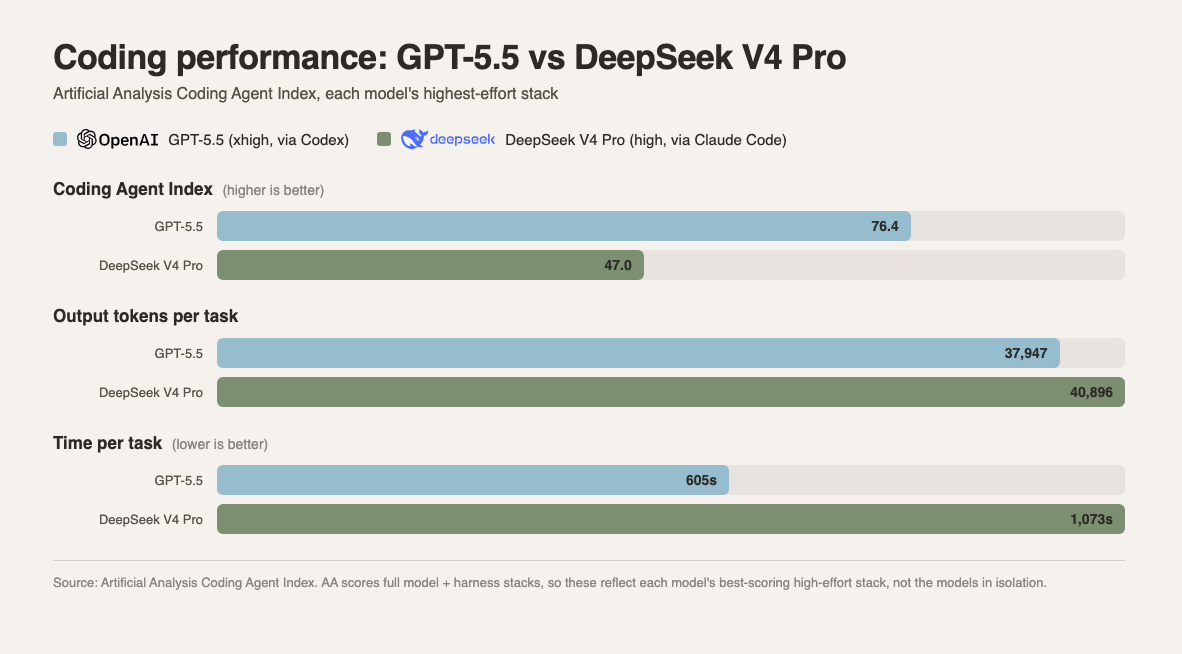
It gets there without being the heaviest generator: it averages around 37,900 output tokens per task and 605 seconds per task, faster than DeepSeek V4 Pro's high-effort run.
That said, DeepSeek V4 Pro’s advantage doesn't show up in the index at all; it's price, which is where our own test picks up.
Note: These figures reflect each model's best-scoring, high-effort stack, GPT-5.5 via Codex and DeepSeek V4 Pro via Claude Code, rather than a pure model-to-model result.
Related: When to use Claude Sonnet over GPT-5.6 Terra (and vice versa)
DeepSeek V4 Pro vs GPT-5.5 (based on our research)
On Artificial Analysis' data, GPT-5.5 is the stronger coder, leading DeepSeek V4 Pro on the Coding Agent Index by a wide margin.
We wanted to see how that played out on a real, self-contained task, so we ran our own test.
Here's what we did:
1. We wrote an identical prompt for both models: build a marketing homepage for a fictional company (Acme Systems, an employee management platform) as a single self-contained HTML file with a dynamic hero section.
2. We routed that prompt to each model through Merge Gateway at high reasoning effort, one generation each, and captured the input tokens, output tokens, total response time, and estimated cost.
3. Then we rendered both results and looked at how the sites actually turned out.
Here's what Gateway measured:
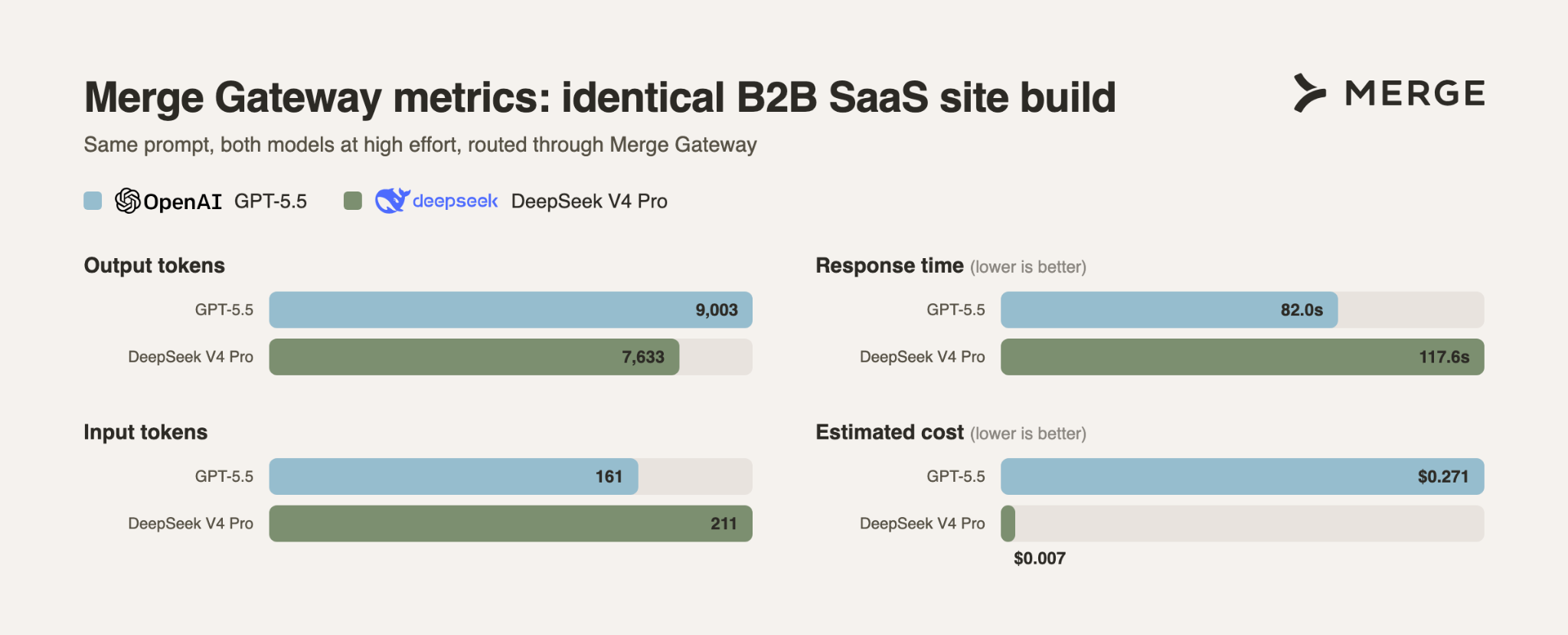
The quantitative story is a clean trade-off. GPT-5.5 was faster (82.0 vs 117.6 seconds) and generated more (9,003 vs 7,633 output tokens). But DeepSeek V4 Pro cost roughly 40x less for the same task ($0.007 vs $0.27), a direct result of its far lower per-token pricing.
The qualitative story tracks the Coding Agent Index.
GPT-5.5 produced the more polished result: a dark, cohesive Acme Systems page with an animated "Workforce Command Center" dashboard mockup, layered employee cards, and a clear visual hierarchy.
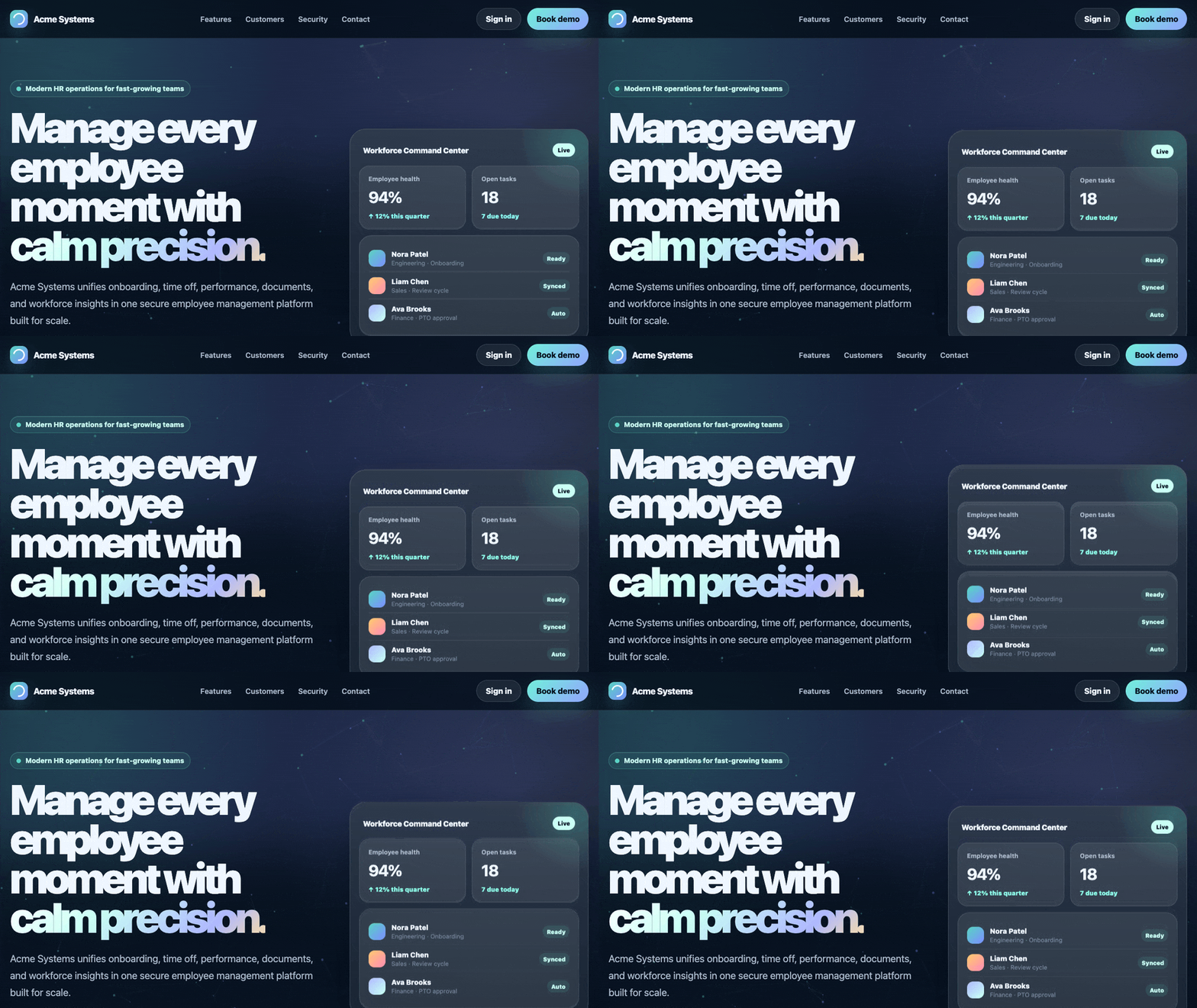
DeepSeek V4 Pro also delivered a working, single-file Acme Systems site with a genuinely dynamic hero and a decent structure (e.g., relevant nav bar).
Its execution was a step behind though. The layout was more generic and doesn’t have a product visualization to anchor the page.
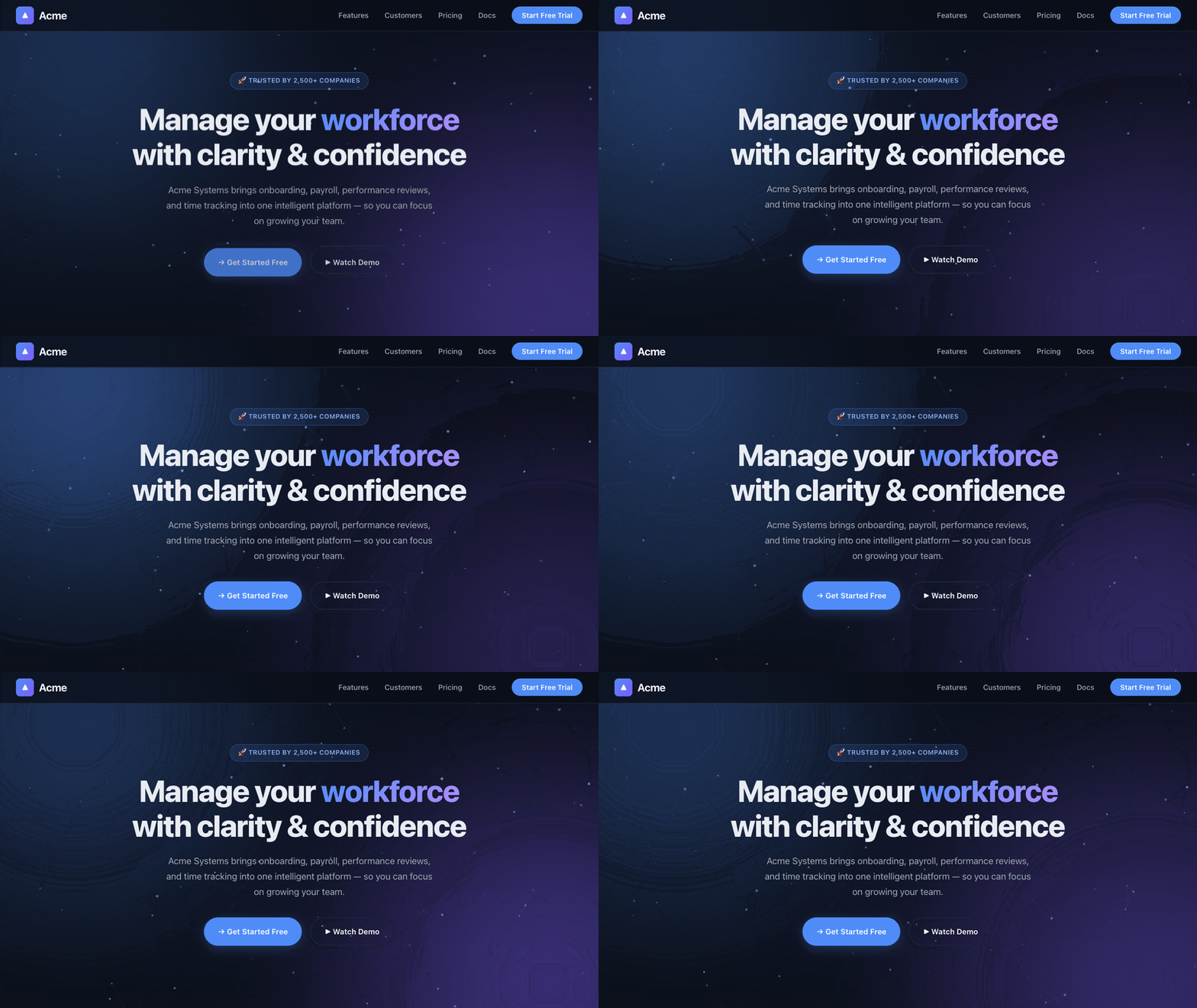
That lines up with Artificial Analysis' conclusion that GPT-5.5 is the stronger coder, and it adds the dimension the index leaves out: for a task where both models produce a usable result, DeepSeek V4 Pro gets you most of the way there at a tiny fraction of the cost.
Related: How Claude Sonnet 4.6 compares with Kimi K2.6 on coding tasks
Final thoughts
Neither model wins outright.
GPT-5.5 is the pick when output quality and speed matter most and the budget can absorb a premium. DeepSeek V4 Pro is the pick when cost and volume matter, since it delivers a solid result for a fraction of the spend, and its open weights let you self-host.
The good news is you don't have to commit to one.
With Merge Gateway, you can route each request to the model that best fits the requirement, and switch as models and prices change.
Merge Gateway also lets you:
- Access every major model through one API, including GPT-5.5, DeepSeek V4 Pro, and the rest of the frontier and open-weight lineup
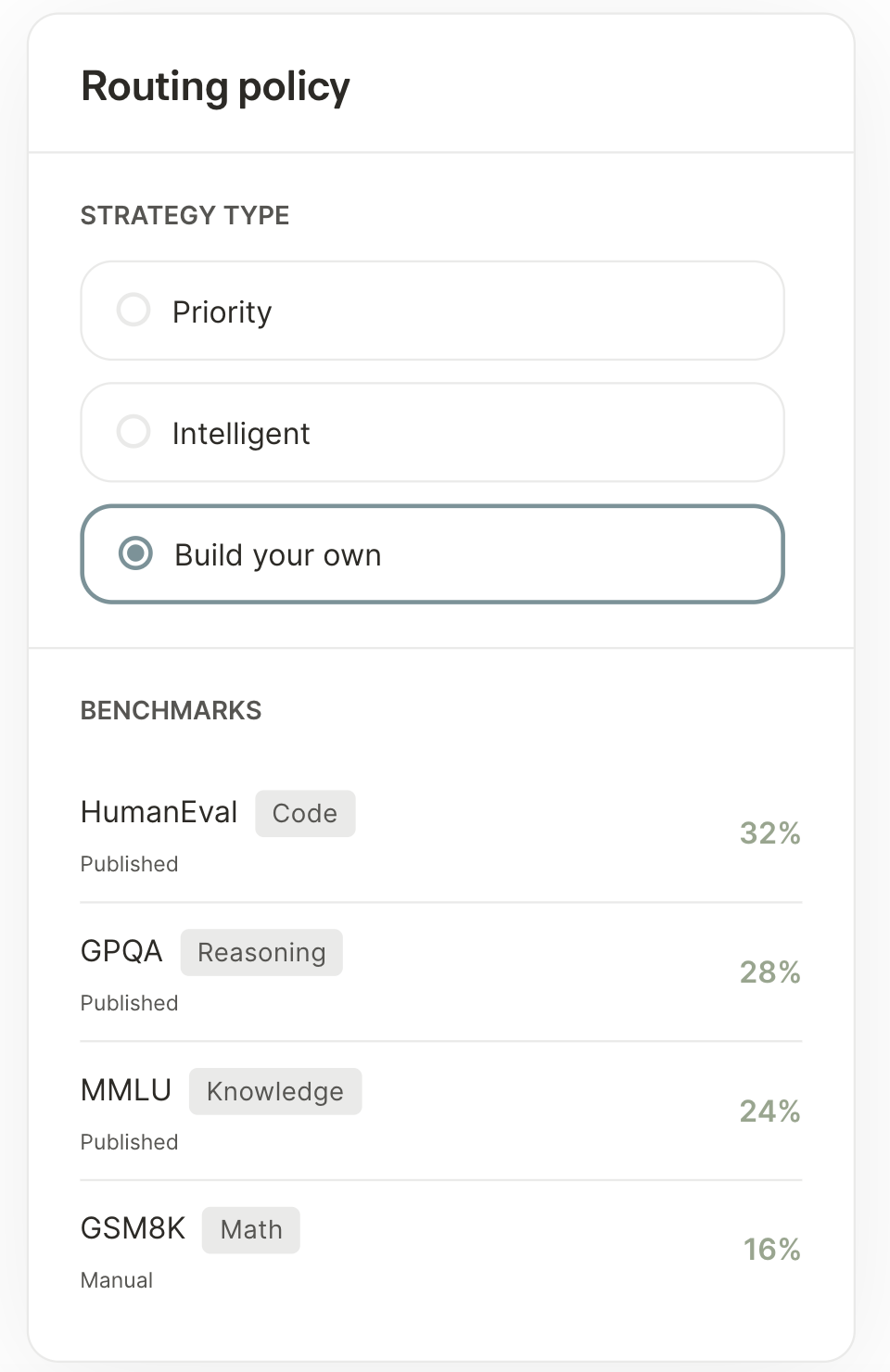
- Build Your Own Router to route on your own benchmark and evaluation scores, so "best" is defined by your data, not just cost or latency
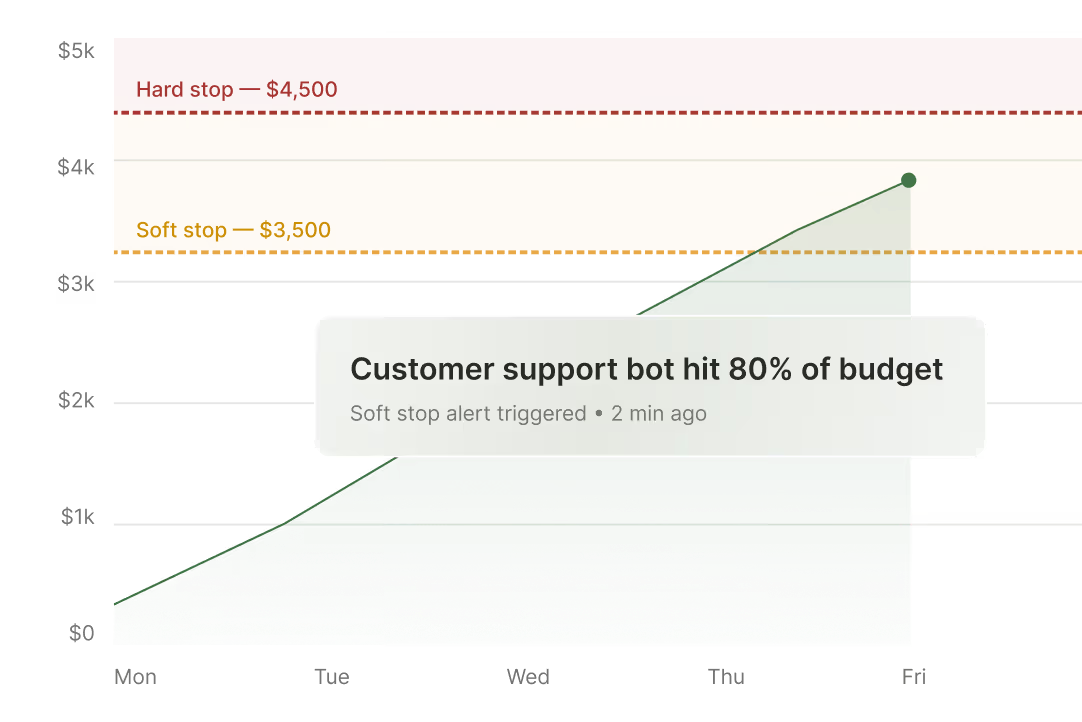
- Govern cost with budgets, spend visibility, and hard or soft limits per project or customer
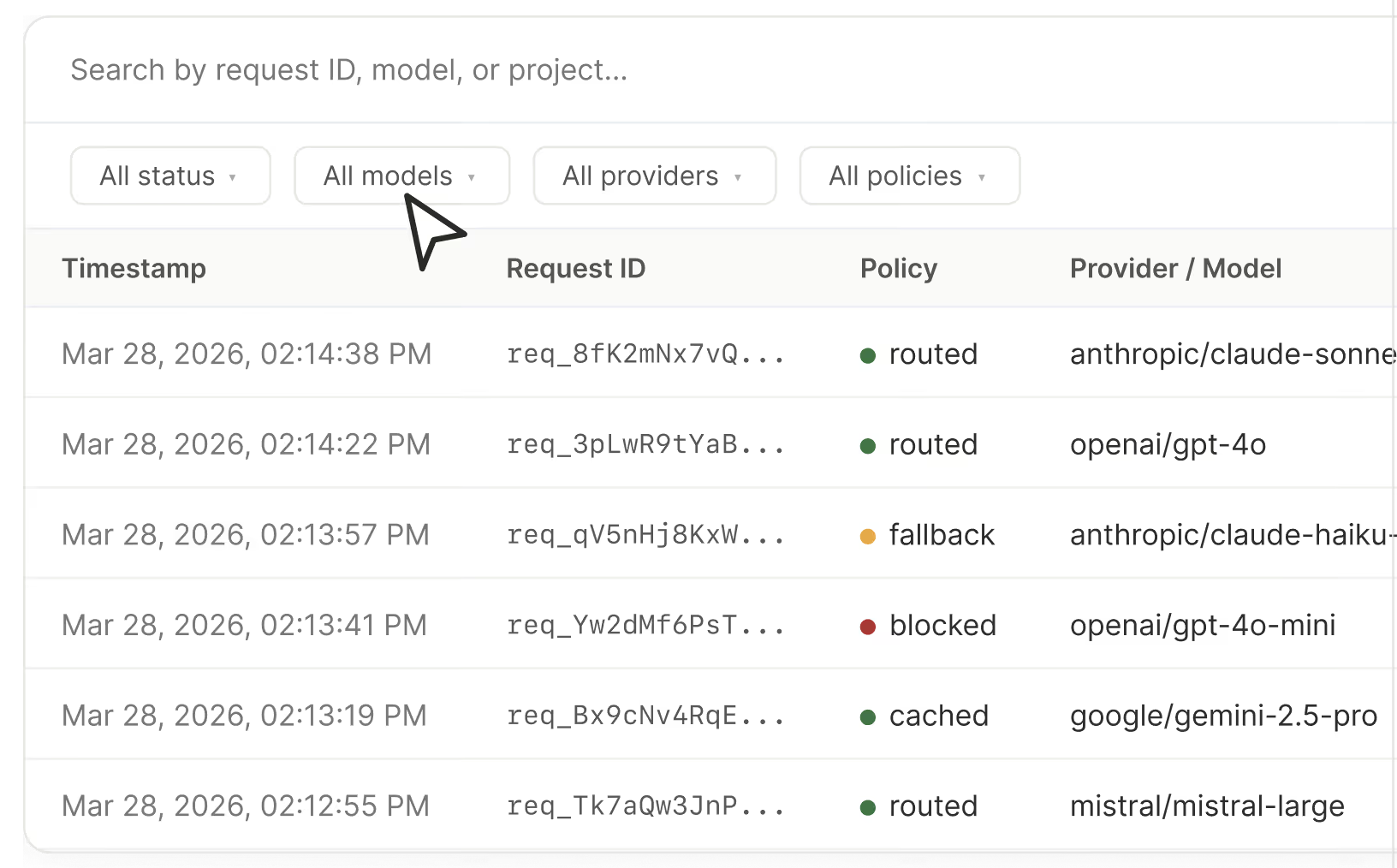
- Observe every call with per-request logging and tracing, so you can see exactly which model handled what, and why
- Stay reliable with automatic fallbacks when a provider is slow or down
{{this-blog-only-cta}}
GPT-5.5 vs DeepSeek V4 Pro FAQ
In case you have any more questions on either model, we’ve addressed several more questions below.
What is the context window for GPT-5.5 and DeepSeek V4 Pro?
Based on OpenAI's API docs, GPT-5.5 has a context window of roughly 1.05 million tokens, with up to 128,000 output tokens per response. And according to DeepSeek's model card, it has a context window of about 1 million tokens, with up to 384,000 output tokens.
Both of these context windows are large enough to hold a substantial codebase, long specs, and multi-file context in a single request, and DeepSeek V4 Pro can return notably longer single responses.
What other models should I consider besides GPT-5.5 and DeepSeek V4 Pro?
Claude Opus 4.8 from Anthropic and Gemini 3 Pro from Google both rank near the top on coding benchmarks, so they’re also worth evaluating.
What are the most common coding use cases for GPT-5.5 and DeepSeek V4 Pro?
GPT-5.5 fits complex, high-stakes work where output quality matters most: agentic multi-step tasks, hard debugging, and polished front-end generation, where its higher Coding Agent Index score and cleaner output justify the premium price.
DeepSeek V4 Pro fits cost-sensitive and high-volume coding: bulk code generation, routine refactors, and pipelines that make many model calls, plus cases where its open weights let you self-host. It gets you a solid result at a small fraction of the cost.
Jon Gitlin
.png)
.png)

Start routing requests to any model with Merge Gateway
Try Merge Gateway for free and route your next coding task to the model that fits it best.


But Merge isn’t just a Unified
API product. Merge is an integration platform to also manage customer integrations. gradient text
But Merge isn’t just a Unified
API product. Merge is an integration platform to also manage customer integrations. gradient text
But Merge isn’t just a Unified
API product. Merge is an integration platform to also manage customer integrations. gradient text
But Merge isn’t just a Unified
API product. Merge is an integration platform to also manage customer integrations. gradient text