

.avif)
.avif)
How we restarted Merge in 2025


Shensi Ding
2025 changed the trajectory of Merge.
Like most companies that started pre-AI, we had to reckon with how fast the industry was changing. By the end of 2024, it became clear that small adjustments weren’t going to be enough. We needed to fundamentally change how we operated so we could keep showing up for our customers as their products and use cases evolved.
So we made a hard internal shift. We focused on three things: using AI deeply inside the company and product, supporting AI use cases for our customers, and launching an AI product of our own to help customers safely build, deploy, and operate AI agents.
We invested heavily in making our Unified API platform AI-native and in enabling our team with AI, so we could deliver a better experience for both our customers and their end users.
Those changes and the team’s hard work translated into higher product quality and the ability to reliably support production-scale, customer-facing use cases. We scaled our platform to handle larger customers, more data, and more demanding workloads, while continuing to move quickly and ship.
Today, Merge makes 1.1 billion daily API requests. And we expanded our support coverage, resolving 12,568 support tickets this year with a median CSAT score of 5 (out of 5).
Merge is trusted to run in production by fast-growing startups and large companies in the world across banking, payments, AI, ride sharing, and streaming.
Here’s what that shift enabled us to build for our customers. Over the past 12 months, we’ve:
- Launched a new product, Merge Agent Handler, now used by the top AI companies in the world
- Expanded Merge Unified with major investments in security and data access, including ACLs, and scopes
- Invested deeply in File Storage to improve sync speed, permissions awareness, and infrastructure scale
- Added Knowledge Base as our seventh Unified API category
- Scaled our infrastructure to support enterprise-grade reliability and high-volume data writes
- Built a new Services team to help customers implement Merge faster
These milestones only scratch the surface.
Below is a closer look at what we built this year—and how each project ties back to our goal of making secure data access easy, whether you’re building software, search, or agents in production.
Merge Agent Handler: The most comprehensive tool-calling platform
Over the last year, the emergence of the Model Context Protocol (MCP) changed how AI systems connect to external tools. MCP made it possible for agents to move beyond text and take real action: creating tickets, updating CRM records, scheduling meetings, generating documents, and triggering routine workflows.
But deploying agents in production introduces real challenges:
- Many public MCP servers aren’t maintained to enterprise-grade standards
- Managing authentication and data access across users is complex
- Security controls must be multi-layered, auditable, and enforceable
That’s why we launched Merge Agent Handler in October: a comprehensive platform to securely connect agents to thousands of pre-built tools, with centralized management and monitoring for every interaction. Merge is the platform to safely unlock the full potential of AI for enterprises.
With this launch, we expanded beyond customer-facing integrations to now support internal agentic use cases. Any company, whether B2C, B2B, or SaaS, can now securely connect internal agents to their own third-party platforms, enabling agents to take action across systems their employees use every day.
Merge Agent Handler supports a wide range of use cases:
- Enable customer-facing agents to take real actions. One of the top AI companies uses Merge Agent Handler to enable their agent to perform customer prompts by reading and writing data in third-party systems
- Boost employee productivity with internal agents. The largest streaming company uses Merge Agent Handler to connect their internal agent to other employee systems (Slack, Gmail, Notion) to deliver a “weekly work digest”. This helps teams move faster by removing manual work
- Automate deterministic, routine tasks with agents. Deploy agents to run in the background such as monitoring logs, checking for anomalies, and sending alerts to on-call teams, so issues are caught early without constant human oversight
Since our launch, we’ve seen strong interest from teams ranging from early-stage startups to Fortune 500s. We’ve been fortunate to launch with partners like Telnyx, who use Merge Agent Handler to ship production-ready agents that need secure, reliable access to third-party systems.
Telnyx is already seeing an impact using Merge Agent Handler. By integrating their voice AI agents with dozens of connectors (including Salesforce, Zendesk, and Greenhouse) within days, Telnyx saved hundreds of engineering hours and kept their team focused on building their voice AI product.
Agent Handler is designed to take agents from concept to production faster and more securely by providing:
- Connector Studio: Modify existing connectors and add your own. Merge Agent Handler allows you to easily import any public MCP in just a few seconds. You can then edit tool schemas, making them specific to your use case

- Tool Packs: Bundle relevant tools and connectors (e.g., Linear, Slack, Wikipedia) that your agent can access, enforcing granular data scopes and permissions and least-privilege controls to prevent unauthorized access

- Playground: Access a secure environment to test agent behavior, simulate real scenarios, and validate tool usage before bringing your agent to production

- Evaluation Suite: Validate that your tools deliver the outcomes you expect to optimize hit rates, success rates, and efficiency

- Security Gateway: Maintain strict data governance with built-in rules, proactive alerts, and real-time logs. With data loss prevention (DLP), Merge Agent Handler scans all tool inputs and responses for sensitive data, preventing your agents from misusing data based on rules you configure.

Security and data governance
While Merge Agent Handler enables agents to take action in real time, many enterprise AI use cases depend on reliable, synced connectors. Merge Unified continues to serve as the foundation for these products, and in 2025 we made investments to strengthen its security, governance, and enterprise readiness.
We gave our customers more control over what data can be accessed and by whom. This is why the top LLMs and AI companies have partnered with Merge to power their enterprise search solutions.
Access control lists (ACLs)
Access control lists define who can read, edit, or view data inside platforms like Google Drive, SharePoint, or Linear. For enterprise AI search and assistants, respecting these permissions is the entire foundation of trust. Exposing data a user shouldn’t see can lead to security risks, compliance violations, and loss of customer trust.
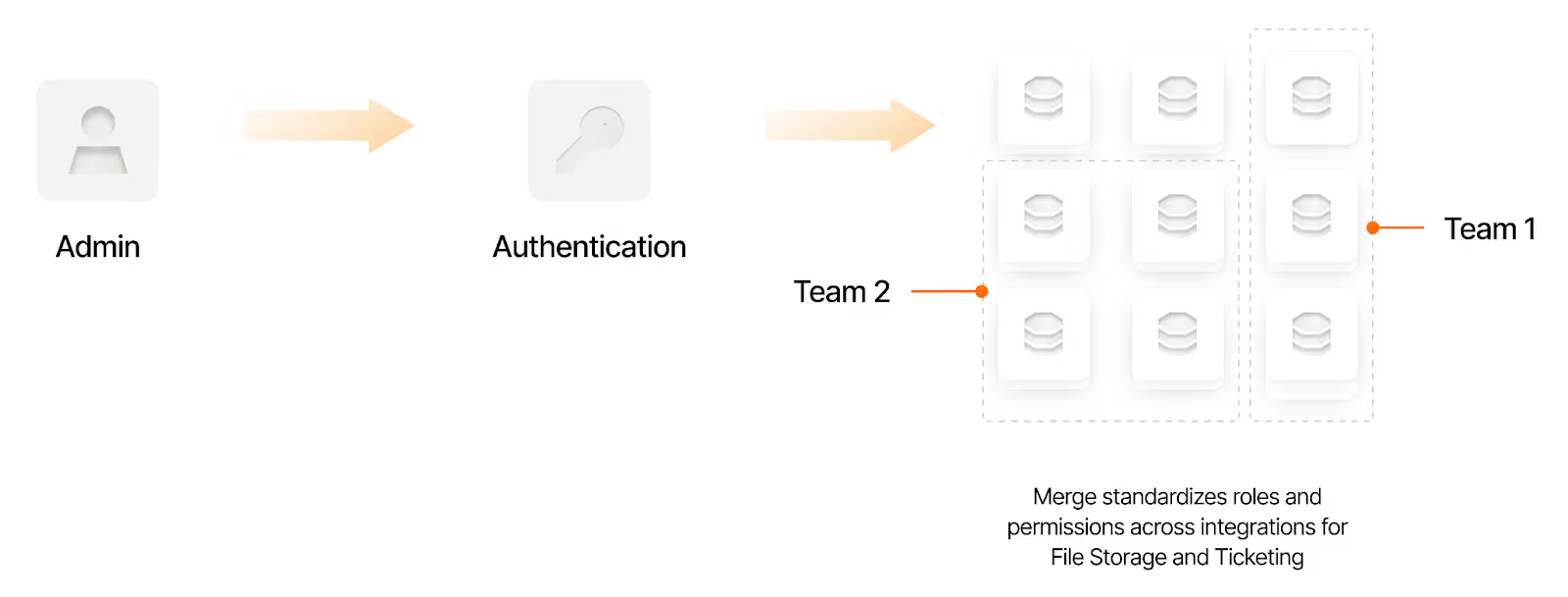
Because of how important this is, we expanded our support of ACLs for Merge Unified. Merge automatically syncs ACLs for file storage and ticketing integrations to keep user permissions up-to-date. You can configure which data and models Merge Unified or your agent can access.
We also implemented ACL Assurance, an internal framework for systematically auditing and validating permissions through extensive automated testing at the field level, ensuring ACLs are accurate across all our integrations.
Mistral, one of our customers, highlights the benefits of using our ACLs:
“Merge’s ability to incorporate ACLs across their file storage integrations ensures that sensitive data stays secure and that our customers keep compliant with key data protection regulations, like GDPR.”
Admin and Super-admin authentication
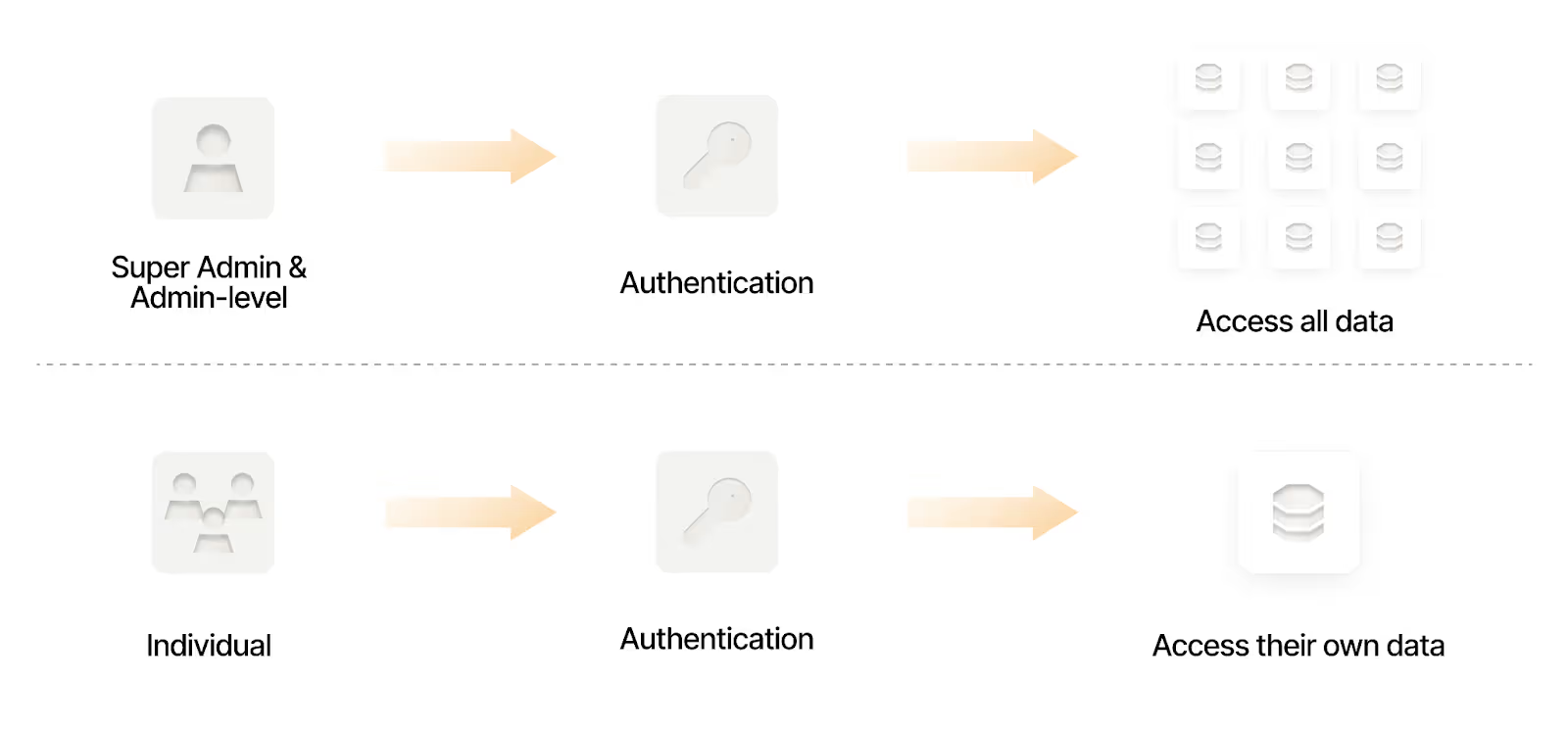
We also built out admin and super admin-level authentication for Merge Unified.
While individual user authentication works well for certain use cases, AI enterprise search often requires syncing data across an entire organization, without forcing teams to connect hundreds or thousands of user-level connections.
That’s why we expanded support for both admin and super-admin authentication, enabling a single connection to securely and efficiently sync org-wide data.
Scopes
Scopes remain one of the most important security features in the Merge platform.
Scopes let you define exactly what your product can access down to specific objects or individual fields. You can easily toggle scopes in the Merge dashboard, programmatically set them via API, or even allow end users to define their own permissions directly in Merge Link when they go through the linking flow.
File storage for enterprise AI search use cases
File data is at the core of enterprise AI search. Everyone has experienced that moment of trying to find a buried onboarding doc, a hidden PTO policy, or an invoice that was “definitely in Google Drive somewhere”.
But connecting to file systems at enterprise scale is hard, especially if you need speed, permissions-awareness, and selective control over what gets synced.
This year, we invested heavily in making our File Storage Unified API category enterprise-ready.
A faster file picker and selective sync improvements
We improved the Merge file picker: our pre-built UI that lets users browse and select files and folders within their storage system. We also rebuilt parts of the underlying infrastructure, including improvements that reduced SharePoint loading times by up to 7x.
We also made major improvements to selective sync for file storage. Users can now choose exactly which files, folders, or drives they want to share, and they can update those selections without needing to relink or reauthenticate.
Direct file download
One of our biggest upgrades to file storage was direct file download.
Historically, many file contents were downloaded through a Merge proxy, meaning data flowed through our servers before reaching your application. With direct download, files come straight from the storage provider (ex. Google Drive, Box, SharePoint) bypassing Merge entirely.
This approach is dramatically faster for large files (we’ve seen download times improve by 2.5x!). We help you manage structure, metadata, and access, while content flows directly to your product.
For enterprise AI use cases that need to process millions of files, this performance and security combination can make all the difference.
Merge Unified: expanding categories and data coverage
Merge Unified continues to be the leading Unified API platform for thousands of companies, and in 2025 we expanded it to meet growing enterprise and AI demand. Not only did we launch 11 new integrations this year, but also launched a brand new Unified API category.
New categories: Knowledge Base and Chat
We launched our seventh Unified API category this year: Knowledge Base. These systems hold key company information that enterprise search products need to access to answer user questions accurately and instantly.
We’re continuing to build out this important category, with a Notion integration planned for next month.
We’ll also be launching our eighth category: Chat. We’re rolling out Microsoft Teams next month, with additional chat integrations like Slack and Google Chat planned. These integrations are also critical for enterprise search because many companies make decisions, updates, and share knowledge within these chat platforms.
Fintech and accounting improvements
We expanded our Accounting API with new Common Models:
- Payment terms and payment methods, enabling more complex bill pay and receivables workflows
- A Project Common Model to tag transactions and automate project-based use cases (ex. consulting companies structure their business by projects)
We’re also investing more in Bank Feeds, with additional platforms planned in Q1 2026 to make reconciliation workflows smoother for fintech customers.
Scale, reliability, and writing data at enterprise volumes
Merge is battle-tested at scale, supporting some of the largest Fortune 500 companies. Here’s how we did it: we continued investing in infrastructure, monitoring, and redundancy across the platform.
Our Foundations Engineering team is constantly running large-scale load tests, tuning autoscaling, optimizing caching and queues, and adding redundancy across critical services. Merge’s infrastructure has made huge strides and now supports 1.1 billion (yes, billion!) requests per day while maintaining enterprise-grade uptime and response times.
To help customers handle high-volume write workflows, we launched Bulk Writes: a feature that lets you create or update millions of records with a single API call. It’s perfect for recurring tasks like pushing invoices or sales orders into an ERP every month.
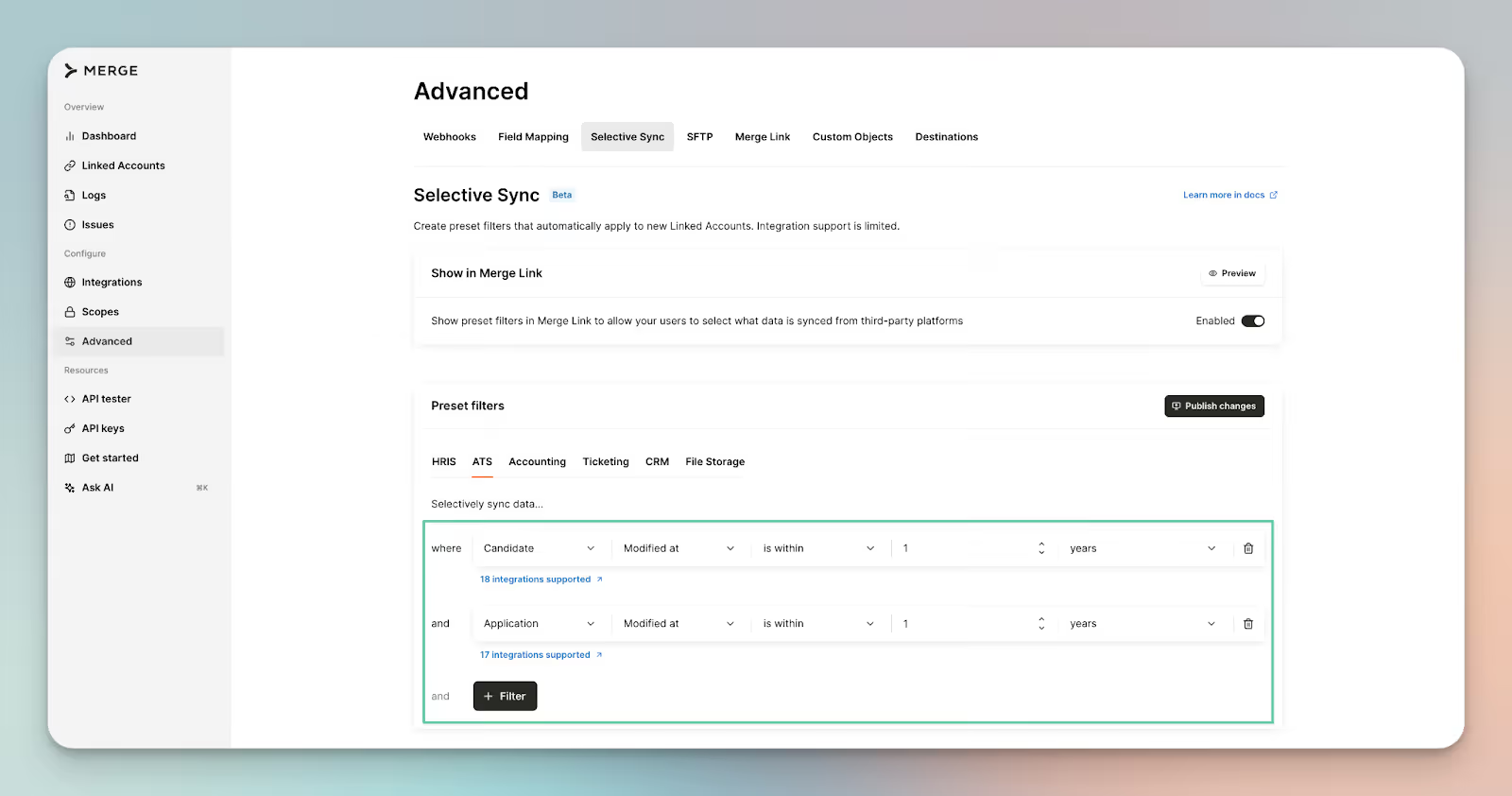
We also rolled out smarter default filters across more ATS, CRM, Accounting Unified categories to speed up initial syncs and reduce unnecessary historical data. For new linked accounts, we now default syncs to the previous year’s timeframe, while keeping it easy to remove that filter if you need more data.
Onboarding, adoption, and your customers’ experience
Product adoption and usage increases when your customers connect your product to systems they already are using. That’s why we continued investing in Merge Link to make user onboarding to your integrations feel effortless and fully native to your product:
- Full customizability (fonts, buttons, colors, and logos) so Merge Link feels native to your brand
- Link Localization expanded to 15 languages, helping your globally distributed customers onboard in their native language
We also introduced improvements to Field Mapping, including enabling customers to manage advanced field mappings directly in Merge Link during onboarding, giving end users more control.
For customers migrating from in-house integrations, we also launched bootstrapping, which allows teams to transition existing users onto Merge with zero disruption. Your customers don’t need to reauthenticate or change their workflows, while product and engineering teams can retire legacy integrations and immediately benefit from Merge’s platform and integrations.
Introducing our Services team
As we’ve onboarded more enterprise customers, we’ve seen that some teams need additional hands to meet aggressive timelines, handle complex authentication requirements, or support large-scale launches.
That’s why we launched our Services arm.
Our Services team works hands-on with customers to implement Merge, customize integrations, and accelerate go-lives. From navigating complex enterprise setups to extending Merge for specific workflows, our Services team goes hands-on keyboard to implement Merge. This means less work on your end and faster implementation.
The best is yet to come
As we look ahead to 2026, it’s clear that integrations are becoming increasingly important to how both software and agents are built. 4 in 5 B2B SaaS companies expect to build 15 or more product integrations next year, while 93% say integrations are critical to developing and improving their agents.
We’re excited to support the teams building the next generation of enterprise and AI-powered products. Their ambition pushes us to keep raising the bar on security, performance, and reliability, across both synced and live connectors.
We can’t wait to help our customers turn their bold product and agent ideas in 2026 into production-grade reality.
Have ideas on how to scale your product in 2026? You can talk to one of our integration experts here.
Shensi Ding
.png)
.png)


But Merge isn’t just a Unified
API product. Merge is an integration platform to also manage customer integrations. gradient text
But Merge isn’t just a Unified
API product. Merge is an integration platform to also manage customer integrations. gradient text
But Merge isn’t just a Unified
API product. Merge is an integration platform to also manage customer integrations. gradient text
But Merge isn’t just a Unified
API product. Merge is an integration platform to also manage customer integrations. gradient text