


.png)
How Payflow saves $300k annually in engineering spend by outsourcing critical integrations to Merge
How Payflow saves $300k annually in engineering spend by outsourcing critical integrations to Merge

Payflow fact sheet
FP&A
Artificial Intelligence
Merge has enabled us to save $300,000 annually in engineering costs. We’ve been able to use that money toward improving Luca’s core agentic capabilities.

Building deep, cross-category integrations required significant developer resources
The team at Payflow needed to add a wide range of integrations to support their FP&A and strategic finance agent, “Luca.”
“Enabling Luca to analyze financial data, generate reports, and provide quick and reliable insights required us to connect to a broad set of systems, including ERPs, file storage tools, HRISs, and CRMs,” explains Wil Eyi, Payflow’s CEO and co-founder.
Implementing all these integrations in-house, however, wasn’t an option.
“Building and maintaining all the integrations we needed would’ve forced me to hire multiple full-time engineers. And that would have taken too many resources away from developing Luca,” says Wil.
This led their team to evaluate 3rd-party solutions, and they ultimately decided between Merge and Paragon.
Stephen Hutchens, Payflow’s CTO and co-founder, explains that Merge offered a faster-time to market and significantly less resource investment:
“Merge allowed us to add the integrations we needed in days, while Paragon’s approach would’ve required several weeks to add each integration through a technical UX and custom builds for nearly every platform.”
He further explains that “Merge would allow our team to avoid hiring several engineers, and it wasn’t clear that Paragon could do the same.”
Adding 100+ file storage, ERP, CRM, and HRIS integrations within weeks via Merge
After spending just a few weeks building to Merge’s HRIS, ERP, CRM, and file storage Unified APIs, they were able to add more than 100 integrations. This includes apps like SharePoint, Sage Intacct, HubSpot, and Netsuite.
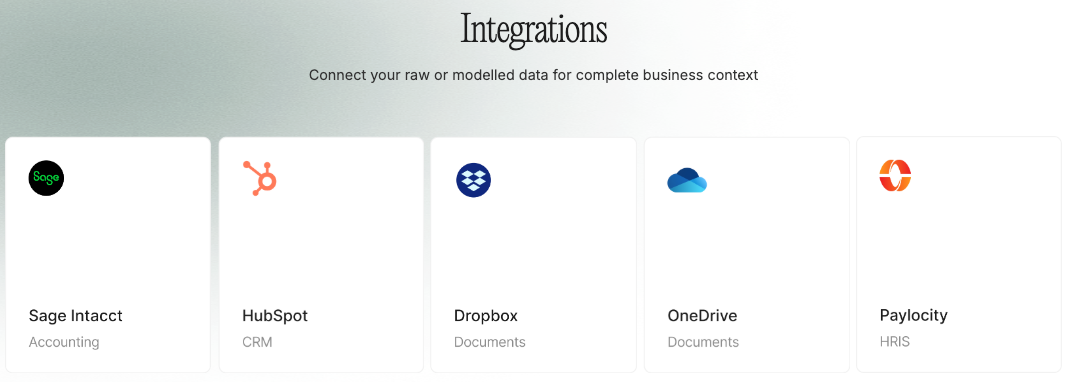
Here’s how their integrations work:
1. A logged-in user would click on “Add Connection” to view all of the integrations they could add.
.png)
2. Once they select an integration, Merge Link, a UI component powered by Merge, appears. The user can follow its instructions to authenticate the integration.
.png)
3. Once the integration is authenticated successfully, Payflow initially syncs a wide range of data from that system. Different data types can also get resynced on varying frequencies, depending on their customers’ requirements.
For example, with ERP integrations, Payflow can sync journal entries, balance sheets, GL transactions, tracking categories, and more. Payflow can resync most of the data every 2 weeks to help customers access fresh data for running scenarios or financial analysis; but they can also resync cash-based transactions every 24 hours to help customers manage their cash flow effectively.
Once the integrated data is populated and continuously refreshed in Payflow, Luca can support critical FP&A and strategic finance workflows end-to-end.
Here are just a few examples:
- Answering ad hoc financial questions: Users can ask Luca executive-level financial questions, and Luca can use the integrated data to answer them visually (e.g., charts) and/or in plain text
For example, a user can ask how their liquidity ratio has trended during a predefined time range and Luca can use GL account balances (from the integrated ERP), department-level headcount and compensation data (from the integrated HRIS), and revenue or discount data (from the integrated CRM) to populate a chart along with context and recommendations for improvement.
.png)
- Performing variance analysis: Luca can compare budgets (from the integrated file storage system) with actuals (from the integrated ERP and CRM) across accounts, or perform a period-over-period financial analysis. Users can then ask Luca to explain the variance across accounts to understand the drivers of change, which Luca can find in near real-time through the integrated data
.png)
- Generating recurring custom reports: Users can ask Luca to create and, on a predefined cadence, update specific reports, such as revenue figures on specific months for products and services (using the integrated ERP and/or CRM). These reports can include contextual insights to help users make informed decisions
Saving $300k in engineering costs while powering the leading FP&A AI agent
By using Merge, Payflow avoided hiring two additional engineers. Wil explains the significance this has had on their business:
“Merge has enabled us to save $300,000 annually in engineering costs. We’ve been able to use that money toward improving Luca’s core agentic capabilities.”
Wil and his team also appreciate the breadth and depth of Merge’s integrations.
“Merge enables our AI agent to access all the applications our customers use as well as leverage granular data within these applications, like journal entry memos and descriptions from ERPs. This allows us to offer the most powerful agent to every customer.”
Finally, the Payflow team loves using Merge’s integration observability features to manage their integrations.
According to Stephen:
“Merge’s logs and real-time alerts make it incredibly easy to debug sync errors and ensure data freshness. This saves our team time and allows us to offer an incredibly reliable agent.”
So, what’s next in Payflow’s integration journey with Merge?
“We plan to add more cross-category integrations through Merge, including Microsoft Dynamics, HiBob, and Gusto.”
We can’t wait to elevate their cutting-edge agent even further.
Customer stories
.webp)

.svg)


Make integrations your competitive advantage
Stay in touch to learn how Merge can unlock hundreds of integrations in days, not years
